Bauer Hockey Stick: Choose Flex, Curve and Kick
Choose a Bauer hockey stick by matching flex to your strength and shooting style, curve to how you handle and release the puck, and kick point to where you want the shaft to load.
The numbers
Classification accuracy for slap shots in the 2022 Sensors study
Classification accuracy for wrist shots in the 2022 Sensors study
Approximate Vicon capture volume around the synthetic ice surface
These choices work together: a flex that is too stiff can make loading the stick difficult, while a curve that feels unfamiliar can change puck control and release. Bauer offers different combinations, so compare the specifications rather than choosing by appearance alone.
This guide explains how to assess flex, curve and kick point, then narrow the options to a stick that suits the way you play.
| Choice | What it changes | Best fit |
|---|---|---|
| Low kick point | Flexes closer to the blade | Quicker puck release |
| Mid kick point | Flexes nearer the shaft center | More shot velocity |
| Hybrid kick point | Balances release characteristics | All-round use |
| P28 curve | Versatile blade pattern | Wrist-shot use |
| P29 curve | Associated with more power | Slap-shot use |
How do you choose a Bauer hockey stick?
Choose a Bauer hockey stick by matching its kick point to your most-used shot, then check flex, blade curve and length against your technique and stance.
- Kick point: Start with your main shot. A low kick point can help with a quick release; a mid kick point suits a heavier shot. A hybrid kick point is an option if you use both styles.
- Flex: Use a flex number a little less than half your body weight as a starting point, not a fixed prescription. How the shaft loads depends on your strength and shooting style.
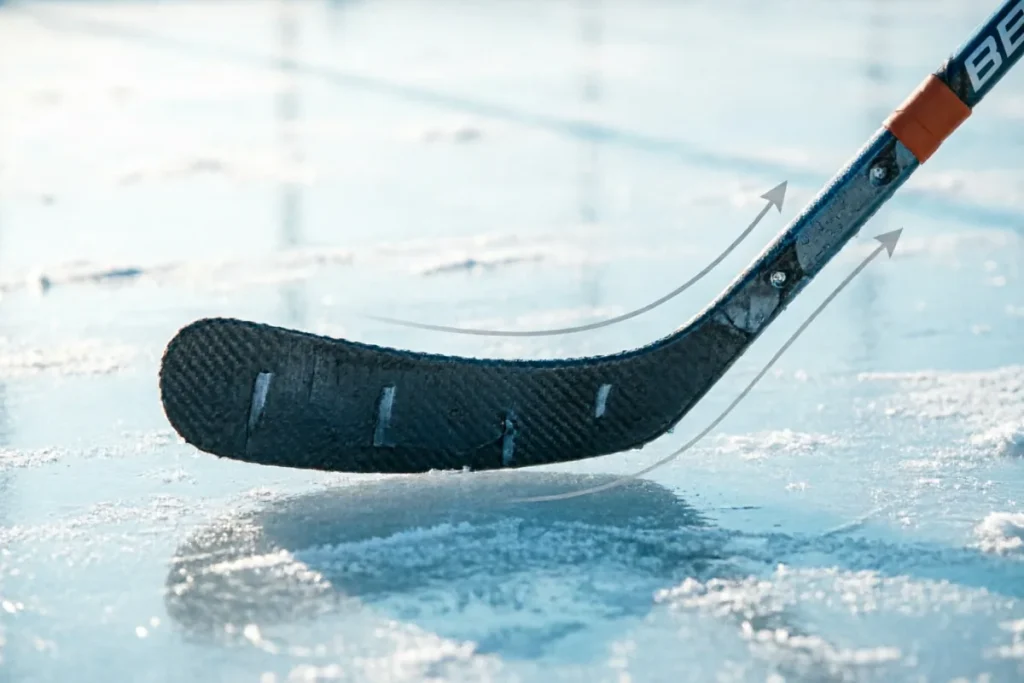
- Blade curve: Compare the curve with how you handle the puck and shoot. Bauer’s P28 is versatile for wrist shots, while the P29 is aimed at adding power to slap shots; choose by feel and technique, not the curve name alone.
- Height: Check the stick in both footwear conditions. It should reach roughly your nose in shoes, or sit between your chin and bottom lip when you are on skates.
Make the final check in your usual stance: a stick that fits your height still needs to feel manageable when you control the puck and take your regular shot.
Which Bauer kick point fits your release?
A Bauer low-kick stick suits a quick release; a mid-kick stick suits a shot where you want to build more velocity, while a hybrid kick point is the compromise for an all-round choice.
- Low kick: The shaft flexes closer to the blade, which can help you get the puck away quickly. Choose it if that fast release matches how you usually shoot.
- Mid kick: The stick flexes nearer the center of the shaft and can add velocity to a shot. It fits a release that uses more of the shaft’s bend.
- Hybrid kick: This is the all-round option when you want a middle ground rather than a kick point aimed at one release style.
Choose by watching your usual shot, not by treating one kick point as an upgrade. If you generally release the puck quickly, a low kick is the relevant feature; if adding velocity is your priority, consider mid kick. When neither describes your release clearly, hybrid offers a compromise.
Kick point describes where the stick flexes most; it does not tell you which option is automatically more advanced. Match the Bauer stick’s kick point to the release you rely on in play.
How should you choose a Bauer blade curve?
Choose a Bauer blade curve by comparing puck control and shot execution, then use the pattern that fits your usual mechanics: P28 is presented as versatile for wrist shots, while P29 is associated with more power on slap shots.
- P28: Consider it if wrist shots are a key part of your game, but test how its curve feels when carrying and controlling the puck.
- P29: Consider it if you want more power on slap shots, and check whether the blade still gives you the control you need.
A curve that helps with one shot may feel less natural for puck handling or another release. Judge the blade on both tasks rather than choosing from its shooting description alone.
Test the curve with your normal shot
When possible, compare Bauer patterns with real pucks. Carry the puck, settle it on the blade, and try your regular shots; pay attention to whether the curve supports your control and the way you normally release the puck.
Choose the pattern that works across those checks. If P28 or P29 feels effective only for a shot you rarely take, it may not be the better fit for your game.
How much can a fitting algorithm tell you?
A fitting algorithm can identify a strong starting specification, but it cannot guarantee that a Bauer stick will feel right in every game situation.
In a 2022 study published in Sensors, fine k-nearest neighbors algorithms classified players by optimal stick flex, blade pattern, and kick point with 90–98% accuracy for slap shots and 93–97% accuracy for wrist shots. The results suggest that shot type can help distinguish which specifications suit a player; they do not make a recommendation universal across different situations.
What the test environment means
The Vicon motion-capture setup used eight T10S, two T40S, four Vantage V5, and four Vero 2.2 cameras around a synthetic ice surface. Its capture volume was approximately 8.0 m long × 3.4 m wide × 2.0 m high.
That controlled setup is different from an ordinary shop fitting, where you may be judging a stick without the same motion-capture conditions. Use an algorithmic result as a comparison point, then assess whether the flex, blade pattern, and kick point work for your release and puck control. The study’s accuracy figures describe classification in its testing context, not a guarantee of performance in every game situation.
When can cutting or extending the stick work against you?
Cutting or extending a Bauer hockey stick can work against you when the new length changes how its flex loads during a shot: cutting makes the shaft stiffer, while an extension makes it more flexible.
A stick that feels right at its original length may not release the puck the same way after you trim it. The flex number alone does not tell the whole story; your finished stick’s length and how it bends under your hands matter too.
Check the finished length and flex together
- Before cutting: Check the stick’s height in the footwear you play in, then assess whether its flex suits your strength and shooting style.
- When comparing sticks: Account for shaft length as well as the printed flex. Two sticks with different lengths may not feel alike, even if their flex numbers match.
- Before choosing a kick point: Make sure the stick’s length, flex and blade curve already suit your shooting habits. A low-kick or mid-kick construction cannot compensate for a stick that feels too stiff, too whippy or wrong for your preferred curve.
If you need an extension, reassess the stick’s feel after fitting it; if you plan to cut, check the resulting height before removing material. Don’t pay extra for a kick-point feature until the basic fit works for you.
What should you check before buying a Bauer stick?
Before buying a Bauer hockey stick, confirm the exact model and its available flex, blade curve and kick-point options with the retailer, then compare those specifications with the stick you already use.
- Model and options: Check the model name and which flex, curve and kick-point combinations are actually available. Do not assume every option is offered across the range.
- Current stick: Compare the listed specifications with your current stick, especially if you already know which flex and release feel reliable. A change in kick point or curve can alter how the stick responds when you shoot.
- Grip and handling: If the retailer has a test area, handle the stick and try its grip. Comfort affects how confidently you can load the shaft—the bend you create as you shoot.
- Fit advice: Ask for a recommendation based on your position and playing style. A flagship label alone does not tell you whether a stick’s flex, curve and kick point suit your game.
For kick point, Bauer describes low-kick construction as flexing closer to the blade, which can help get the puck off quickly; mid-kick flexes nearer the centre of the shaft and can add shot velocity. Check the exact kick-point description for the model you are considering.
Frequently asked questions
What flex should I choose for a Bauer hockey stick?
Is P28 or P29 better for a Bauer stick?
What does a low kick point do?
How tall should a hockey stick be?
Key takeaways
- Start Bauer stick flex at a little less than half your weight, then assess how easily you load the shaft.
- Choose low kick for a quicker release, mid kick for added shot velocity, or hybrid for an all-round option.
- P28 suits wrist-shot versatility; P29 is associated with slap-shot power.
- Cutting increases stiffness, while an extension lowers it.
- Check stick height in shoes and skates before trimming.
Sources
- info.hockeybase.fi — “Hockey Stick Buying Guide 2025: Flex, Kick Points & Blade Selection”
- R&M Hockey Supply — “Hockey Stick Sizing & Buying Guide”
- bauer.com — “The Ultimate Hockey Stick Buying Guide”
- warrior.com — “HOCKEY STICK BUYING GUIDE”
- puckstop.com — “How to Choose the Right Ice Hockey Stick Size and Flex”