When Does Arch Support Help or Hurt in Hockey Skates?
Arch support helps in hockey skates when it fits your foot and reduces strain or pressure; it can hurt when it forces your arch into an uncomfortable position or creates painful pressure points.
The numbers
Shoe-size range listed for CCM OrthoMove X-Large by GoalieMonkey
Original price listed for CCM OrthoMove Hockey Insoles by GoalieMonkey
Saving listed for CCM OrthoMove Hockey Insoles by GoalieMonkey
Support is not automatically better or worse: the right amount depends on your foot shape, the skate’s fit and how the support feels while you skate. A sore arch, numbness or a new pressure point is a reason to reassess the setup rather than push through.
Here’s how to tell whether arch support is helping, when it may be causing trouble, and what to check before changing your skates or insoles.
| Fit situation | Possible benefit | Risk to check |
|---|---|---|
| Low arch with inward rolling | Stability-focused support may help steady the foot | Arch pressure if the contour is too high or poorly placed |
| High arch | A matching contour may improve contact under the arch | Pressure concentrated at the arch or heel |
| Close-fitting boot | A correctly shaped footbed may improve heel positioning | Reduced room over the instep and toes |
| Custom-shaped footbed | Can match the skater’s foot shape and support alignment | Still needs to fit the skate’s internal volume |
What does arch support change inside a hockey skate?
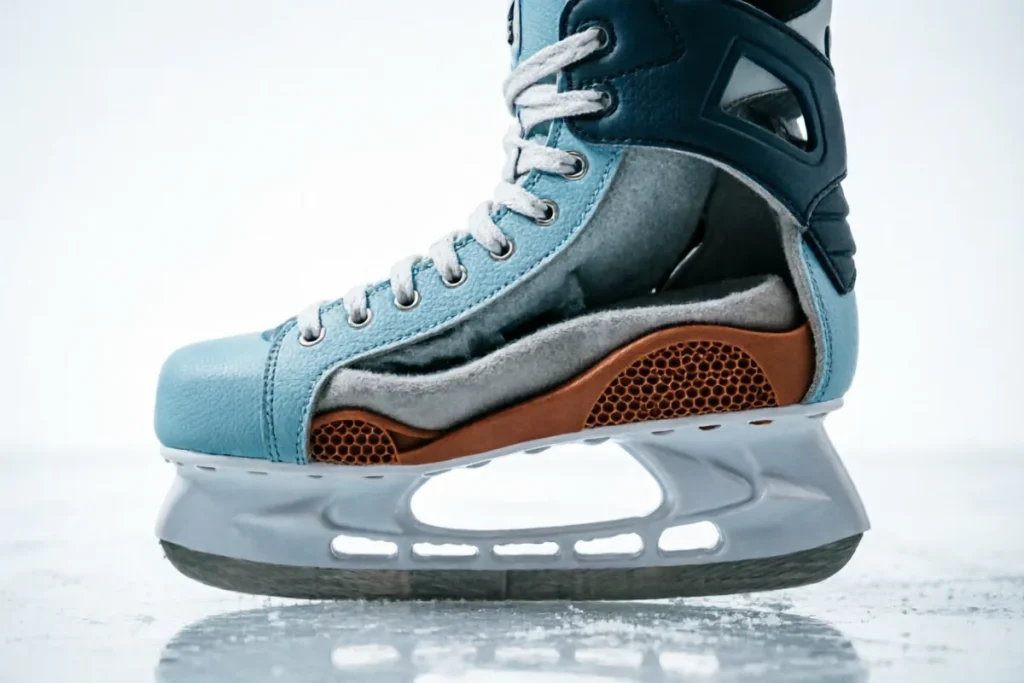
Arch support changes where the arch and heel are held inside a hockey skate, which can affect stability and heel position during push-offs. The insole sits between your foot and the skate’s original footbed, so its contour changes the contact points without changing the boot itself.
The CCM OrthoMove Hockey Insoles feature CCM’s PowerGrid Technology in the footbed. That product detail does not, by itself, determine whether the arch contour suits your foot.
Check the fit in the boot
A suitable arch contour can help keep the heel positioned during a push-off and make the foot feel more stable. But support is not a cure-all: your arch shape, any pressure points, and the space available inside the boot all affect how the insole feels.
- Standing: Check whether the arch feels supported without a sharp or concentrated pressure point.
- Flexing: Bend your knees and flex in the skates to see whether the heel stays comfortably positioned as you move.
- Boot space: Notice whether the insole makes the skate feel too tight or changes how your foot sits in the boot.
Judge the insole while standing and flexing in the skates, not by arch height alone; if pressure or fit worsens, reassess the contour and available boot space.
When can low or high arches benefit from support?
Low or high arches can benefit from support when the insole’s shape addresses the pressure pattern without causing new discomfort.
- Low arches: If your foot rolls inward and pressure or pain follows, a stability-focused insole may help guide it into a steadier position. It should not force your arch into a shape that feels painful.
- High arches: If the footbed does not contact your arch, pressure may remain concentrated elsewhere on your foot. A more contoured footbed may spread contact more comfortably.
- Custom insoles: An insole made to match your foot’s shape may support alignment across arch types. Its shape alone does not guarantee a good fit inside a hockey skate.
Check any insole in the skate, not just underfoot outside it. The boot’s fit can change how the foot sits on the footbed, so pay attention to whether pressure or pain develops during skating. If the support feels uncomfortable, it may be the wrong shape or fit; don’t treat pain as something the arch needs to adapt to.
How do pressure points and skate volume change the fit?
An aftermarket insole can change skate fit by lifting your foot inside the boot, reducing space over the instep and around the toes. Even a well-shaped arch support may cause pressure if the skate already fits closely.
Judge the insole by how your foot sits in the whole skate, not by its arch shape alone. These signs can indicate that the insole and boot are not working together:
- New arch hot spot: pressure has appeared where the insole supports the arch.
- Pinching across the instep: the raised foot has less room beneath the skate’s upper.
- Heel movement: the foot may no longer be held securely in the boot.
- Toe pressure: the foot has less room at the front of the skate.
Check the skate, not just the footbed
The CCM OrthoMove Hockey Insoles feature CCM’s PowerGrid Technology in the footbed. That product feature does not establish whether the insole will fit your skate: assess the skate on your foot, including instep pressure, toe room and heel hold.
If discomfort starts after changing insoles, compare the fit with the original footbed. A thicker or more supportive replacement can create pressure in a close-fitting skate even when its arch contour seems suitable.
When can an aftermarket insole make pain worse?
An aftermarket insole can make pain worse when its arch is the wrong height or shape for your foot, adding pressure instead of relieving it.
A high arch on aggressive support may feel poorly matched; a low arch without enough stability may also remain uncomfortable. The right choice depends on your symptoms and how the skate fits, not just the arch label on the insole.
- High arch: If firm support presses into the arch, stop using it rather than assuming the pressure must be broken in.
- Low arch: A stability-focused insole may help, but ongoing discomfort means the support may not suit your foot or skate.
- Boot-fit problem: An insole cannot fix a boot that pinches, lets your heel move, or leaves too little room over the instep.
Persistent pain calls for an assessment of both foot and skate fit. Replacing insoles repeatedly based only on their labels can leave the cause—pressure, heel movement or limited instep space—untouched. Check how the boot holds your heel and where it presses before choosing another insole.
How should you check an insole before skating?
Check an insole by comparing it with the original footbed, then testing the fit in your skate while standing and flexing into a skating stance.
- Compare the footbeds: Check the replacement against the original for length, heel position and thickness. Place it in the skate and make sure it lies flat.
- Check the fit: Put on the skates and note any new pressure at the arch, heel, toes or instep. Flex into a skating stance and check those areas again; an insole that feels acceptable upright may press differently when you bend your knees.
Check sizing and price before buying
GoalieMonkey lists the CCM OrthoMove Hockey Insoles in X-Large for shoe sizes 9 – 10.5 and describes its sizing chart as a general guideline. Compare the listed size with your shoe size, then confirm the fit in your skate: a chart does not establish whether the footbed matches your boot’s length, heel position or thickness.
GoalieMonkey lists an original price of $49.99 and a 32% saving for the CCM OrthoMove Hockey Insoles. Prices and discounts can change, so check the retailer’s current listing before buying.
Frequently asked questions
Can arch support help a low arch in hockey skates?
Can an insole make hockey skates feel tighter?
Should you choose an insole by arch type alone?
Is the CCM OrthoMove sizing chart exact?
Sources
- willies.co.uk — “Pain In Your Ice Skates? Here’s How To Fix It”
- amazon.com — “CURREX HockeyPro Insoles for Hockey Skates & Ice”
- theinsolestore.com — “Hockey Insoles”
- upstep.com — “Best Insoles for Hockey Skates for Enhanced”
- superfeet.com — “Superfeet Hockey Insoles: The Ultimate Assist”