How to Do Forward Swizzles on Ice
To do forward swizzles on ice, bend your knees, turn your toes inward, then press your feet outward and bring them back together. Repeat the motion to glide forward without lifting your skates.
Forward swizzles help beginners practise balance, edge control and coordinated leg movement. Keep your upper body steady and make each outward-and-inward sweep smooth; this guide breaks down the movement and common points to watch as you learn.
| Phase | Foot position | Control cue |
|---|---|---|
| Start | Heels together, toes out in a V | Bend knees and ankles |
| Open | Feet move outward into an A | Press gradually through inside edges |
| Close | Feet return together | Keep both blades on the ice |
| Reset | Return to the V position | Pause if balance feels unstable |
What is a forward swizzle?
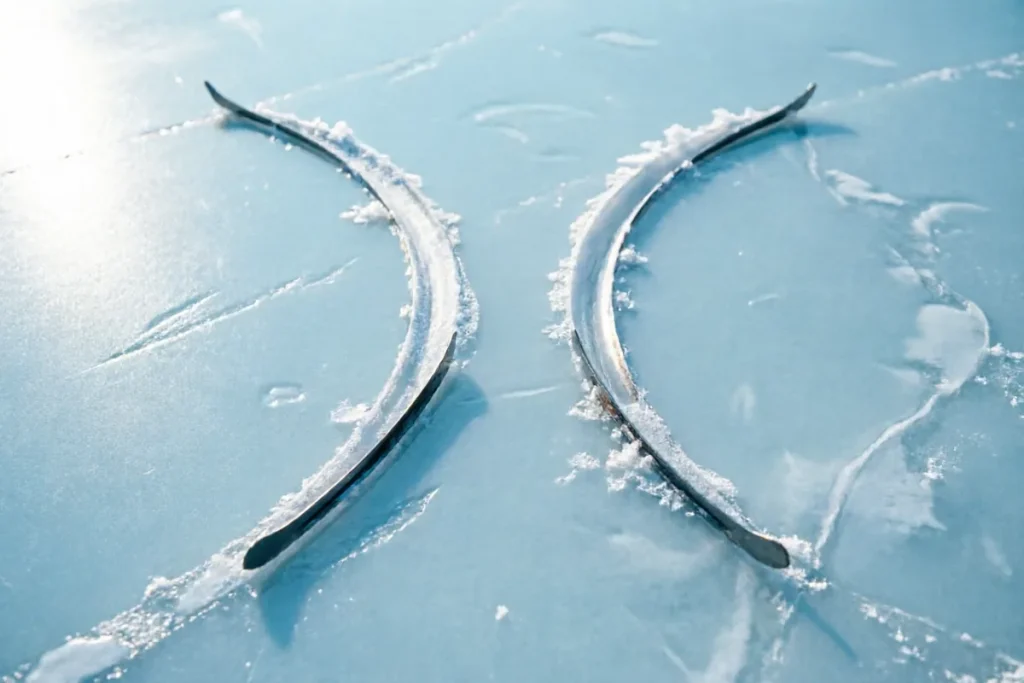
A forward swizzle is a glide in which both feet open outward and draw together again while both blades stay on the ice. The feet trace paired, lemon-like curves: the tracks are narrow where the skates meet and widen as they sweep apart.
In a forward swizzle, the skater begins with heels together and toes turned slightly outward in a V shape. As the feet move apart and return, pressure through the blade edges creates the movement; the skates are not lifted or stepped forward. The continuous contact with the ice is what makes a swizzle a glide rather than a series of steps.
Forward swizzles introduce edge pressure while the skater remains on both blades. The outward sweep and inward return let a beginner feel how changing pressure guides the skates across the ice.
How do you set up the starting position?
Set up for a forward swizzle with your heels together and your toes turned slightly outward in a V. Keep both skates parallel and make sure you feel balanced before you begin.
Soften your knees and ankles while holding the V stance; don’t lock your legs. This ready position lets you bend before pressing your feet outward, the first movement of the swizzle.
How do knee bend and outward pressure create the glide?
Open
Knee and ankle bend lets you press both skates outward on their inside edges, opening the starting V into an A without lifting or kicking your feet. Keep the pressure controlled: the blades stay on the ice as your legs move apart, tracing the first half of the lemon shape.
In a forward swizzle, the bend helps keep your weight low enough to guide the blades rather than shove them. Keep your torso quiet and centered over the skates; let the legs do the moving while your upper body stays balanced.
Then close
As the skates reach the open A position, ease the pressure and draw your feet back together in a smooth, even motion. This inward return completes the lemon-shaped track. Avoid snapping the feet together or leaning your chest forward: a controlled close keeps the glide continuous and your balance over the blades.
How can you stay balanced through each swizzle?
Keep your head level and shoulders relaxed through each forward swizzle, with your weight balanced over both skates. Bend at the knees and ankles rather than leaning your upper body over your toes; that keeps your stance centred as your feet move apart and return.
Make the outward sweep small enough to control, then draw your heels together smoothly to finish the lemon-shaped glide. If your stance starts to feel unstable, pause instead of forcing another swizzle. Set your skates back in the V position and begin again when you feel steady.
What mistakes interrupt a forward swizzle?
Forward swizzles are interrupted when straight knees, a lifted foot, an abrupt push or a tilted, twisted upper body disrupts the two-blade glide. These errors make it harder to control the outward-and-inward movement from the starting V shape into an A shape and back together.
Keep a soft bend in your knees through both the opening and closing phases; straightening them reduces control over the blades. Press outward gradually rather than forcing the feet apart. A sudden push can spread the skates too quickly, making the swizzle harder to guide.
Keep both blades on the ice throughout the movement: lifting one foot turns the glide into a step. Hold your upper body centred over the skates, with your shoulders untwisted. Leaning forward or rotating the shoulders can shift your balance away from the blades and interrupt the smooth return of your feet.
Who can start in an adult beginner class?
San Mateo Adult Beginning is open to skaters ages 16 & up, and no previous skating experience is required. It suits adults who are new to the ice and want a class setting for practising forward swizzles.
The class is listed as equivalent to Beginner 1 and Pre-Alpha. That places it alongside beginner-level instruction, while giving learners a structured opportunity to practise the V-to-A swizzle pattern: start with heels together and toes turned out, press the feet apart, then draw them back together.
What class comes after beginner swizzles?
After beginner swizzles, follow the rink’s class prerequisites rather than moving straight to advanced skills. At San Mateo, skaters must pass Delta 2 (Pre-Freestyle) before enrolling in Freestyle 1–5; completing a swizzle alone does not meet that requirement.
Forward swizzles are a basic glide: the skater presses the feet outward and draws them together without lifting them from the ice. They build familiarity with gliding and blade edges, but they are not clearance for jumps, spins or other advanced skills.
What the next classes cover
San Mateo’s Freestyle 1–5 class is the next named pathway after Delta 2 (Pre-Freestyle). Freestyle 6 & up covers jumps, spins, edgework and footwork, so check the rink’s prerequisites before progressing to that class.
Frequently asked questions
Do I lift my feet during a forward swizzle?
No. Keep both blades on the ice as the feet open into an A shape and close again.
What should my knees do?
Keep them softly bent, along with the ankles, while pressing the feet outward and drawing them back together.
Why do my feet shoot apart?
The outward pressure may be too abrupt. Reduce the sweep and press gradually through the inside edges.
Can an adult with no skating experience take a beginner class?
San Mateo Adult Beginning is listed for ages 16 & up and requires no previous skating experience.
Key takeaways
- Begin with heels together and toes turned outward in a V.
- Use bent knees and ankles to control the outward sweep.
- Keep both blades on the ice as the feet open and close.
- San Mateo's Freestyle 1–5 class requires Delta 2 (Pre-Freestyle).
Sources
- broadmoorworldarena.com — “LEARN TO SKATE USA – Basic Techniques”
- pinelandfarms.org — “Ice Skating at Pineland Farms: A Beginner's Guide – Pineland Farms, Inc”
- instructables.com — “How to Ice Skate – Beginner/Advanced Beginner : 11 Steps”
- redbull.com — “Beginner Figure Skating Moves to Build Confidence”
- activesgcircle.gov.sg — “How to perform a forward swizzle?”