Olympic Ice Hockey Venues: Rink Size, Ice and the Arenas
Olympic ice hockey is played in ordinary arenas made to meet an unusual brief: a rink built to the right size, ice hard enough for two games a day, seats for a big crowd and room for cameras, all for about two weeks. The choice of rink size in particular changes how the game is played.
Updated: October 19, 2026
This guide explains what an Olympic hockey venue has to provide, why the size of the ice matters, and how recent Games handled it, from Lake Placid in 1980 to Milano Cortina in 2026.
| Games | Main hockey arena | Second venue | Worth knowing |
|---|---|---|---|
| Vancouver 2010 | Canada Hockey Place (Rogers Arena) | UBC Thunderbird Arena | First Olympic tournament on NHL-size ice; Sidney Crosby’s overtime gold-medal goal |
| Sochi 2014 | Bolshoy Ice Dome | Shayba Arena | Both arenas in the coastal Olympic Park |
| PyeongChang 2018 | Gangneung Hockey Centre | Kwandong Hockey Centre | No NHL players |
| Beijing 2022 | National Indoor Stadium | Wukesong Sports Centre | No NHL players |
| Milano Cortina 2026 | Milano Santa Giulia Arena | Temporary rink in the Fiera Milano halls at Rho | NHL players returned |
What does an Olympic hockey venue have to provide?
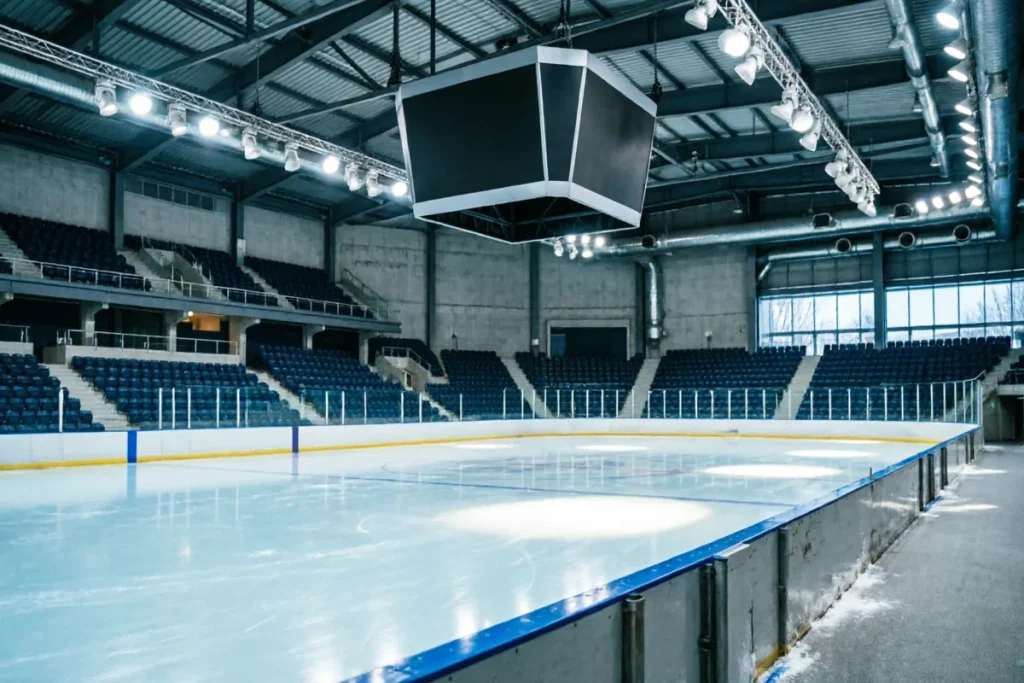
An Olympic hockey tournament needs two rinks close together, because men’s and women’s games run side by side, plus practice ice for every team. Each competition rink needs:
- A rink of the agreed size, with boards, glass and nets to international standard.
- Hard, consistent ice that survives several games a day with only resurfacing in between.
- Dressing rooms, medical rooms and a doping-control area for teams that change every few hours.
- Broadcast space: camera positions, lighting bright and even enough for television, and room for commentary positions.
- Seats for a large crowd, with sightlines that work from every side.
Host cities rarely have two such arenas spare, so most Games combine an existing arena with a new or temporary one. Temporary rinks are built inside exhibition halls or sports halls: the ice plant, boards and stands are installed for the Games and taken out afterwards.
Why does the size of the rink matter?
The two common rink sizes are the NHL rink and the international one. An NHL rink is 200 by 85 feet (about 61 by 26 metres). The international rink used for most IIHF events has been up to 60 by 30 metres, about 15 feet wider, and IIHF rules now accept rinks from 26 to 30 metres wide.
- Narrower ice leaves less time and space: more contact along the boards, quicker decisions and more shots from close range.
- Wider ice rewards skating and puck control: teams can carry the puck wide, and defenders have more ground to cover.
- Players adapt either way, but a tournament played on the size most of its players know has fewer surprises.
Vancouver 2010 was the first Olympic tournament on NHL-size ice, played at the Canucks’ arena under its Games name, Canada Hockey Place. Which size a Games uses is agreed between the IIHF, the organisers and, when its players take part, the NHL.
How is the ice kept fast through a tournament?
Hockey ice is kept colder and harder than figure skating ice, so pucks slide fast and blades bite without cutting ruts. An Olympic schedule makes that harder than a normal season: several games a day, short gaps between them, a full building that adds heat and humidity, and sometimes figure skating or short track sharing the same arena.
- Resurfacing between periods lays a thin film of hot water that freezes into a smooth new surface.
- Dehumidification keeps moisture from settling on the ice as frost or fog.
- Steady temperatures in the slab and the air matter more than any single setting.
For how arena ice changes over a day, see why arena ice quality changes fast, and for the full list of what a competition rink needs, what makes an ice arena competition-ready.
What have Olympic hockey arenas remembered?
- Lake Placid, 1980: the “Miracle on Ice”, when a team of American college players beat the Soviet Union on 22 February in the Olympic Fieldhouse, now the Herb Brooks Arena.
- Vancouver, 2010: Sidney Crosby’s overtime goal against the United States on 28 February won Canada the gold medal on home ice.
What happens to the venues after the Games?
An arena that already had a tenant goes straight back to it: Canada Hockey Place became Rogers Arena again, home of the Vancouver Canucks. New arenas need a plan for concerts, events or a club team, and temporary rinks are dismantled so the hall returns to its normal use. That is why recent hosts have preferred existing and temporary venues over building two new arenas.
The short version
- An Olympic tournament needs two competition rinks, practice ice and broadcast-ready buildings.
- An NHL rink is 200 by 85 feet; the international rink has been up to 60 by 30 metres, and the width changes how the game is played.
- Vancouver 2010 was the first Olympics played on NHL-size ice.
- Hockey ice is kept colder and harder than figure skating ice, and a tight schedule makes that harder.
Common questions
What size is an Olympic ice hockey rink?
It depends on the Games. Recent tournaments have used either the NHL size, 200 by 85 feet, or the wider international size of up to 60 by 30 metres.
Is an NHL rink smaller than an international rink?
It is narrower: 85 feet (about 26 metres) wide against up to 30 metres, and about the same length.
Why do the Olympics use two hockey arenas?
The men’s and women’s tournaments run at the same time, so one rink could not fit every game.
Where was the Miracle on Ice played?
In the Olympic Fieldhouse at Lake Placid, New York, in 1980. It is now called the Herb Brooks Arena.
Sources
- IIHF — “Official Rule Book”
- NHL — “Official Rules: Rink”
- olympics.com — Olympic ice hockey venue and results pages, 1980–2026