What Makes an Ice Arena Competition-Ready?
An ice arena is competition-ready when it can provide a consistent, safe skating surface and reliable conditions for athletes, officials and spectators. That means the ice, rink layout, lighting, equipment and support spaces must suit the event and operate together without disrupting competition.
Updated: October 13, 2026
Meeting those needs takes more than making the rink cold enough. Ice quality affects speed and control; clear markings and functioning equipment help competition run smoothly; and the surrounding facilities must support the people who use them. What makes an ice arena competition-ready is the coordination of these details, matched to the demands of the sport.
| Criterion | Multipurpose rink | Competition-ready arena |
|---|---|---|
| Ice layout | May be adapted for different uses | Configured to the event’s rules |
| Ice conditions | May offer general-purpose operation | Monitoring and adjustment suited to the discipline |
| Spectator setup | Seating may be available | Sightlines checked for the event layout |
| Event infrastructure | Some facilities may be temporary or absent | Required officials’, team and technical facilities confirmed |
How do rink dimensions differ between winter sports?
Hockey, figure skating and curling use sport-specific ice layouts, so no single rink design is suitable for every competition. The differences include the playing area and its markings: a hockey setup needs boards, goal lines and face-off markings that comply with the rules for the event, while figure skating needs clear ice and uninterrupted views for judges, cameras and spectators.
Check the surface and markings before booking
Arena dimensions and ice markings should be checked against the governing rules for the competition being hosted. Hockey requirements are event-dependent, and a surface that suits one set of rules cannot be assumed to suit another sport.
- Hockey: verify the measured ice surface, boards, goal lines and face-off markings against the event’s rules.
- Figure skating: confirm that the ice is clear and sightlines remain unobstructed for judges, cameras and spectators.
- Curling: check the arena’s layout against the curling competition’s requirements rather than assuming a hockey or figure-skating setup will work.
How does temperature control affect competition ice?
Surface and arena air
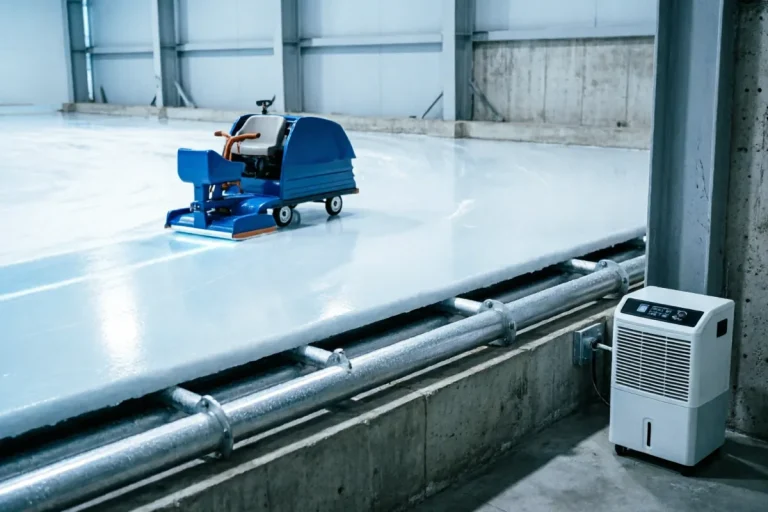
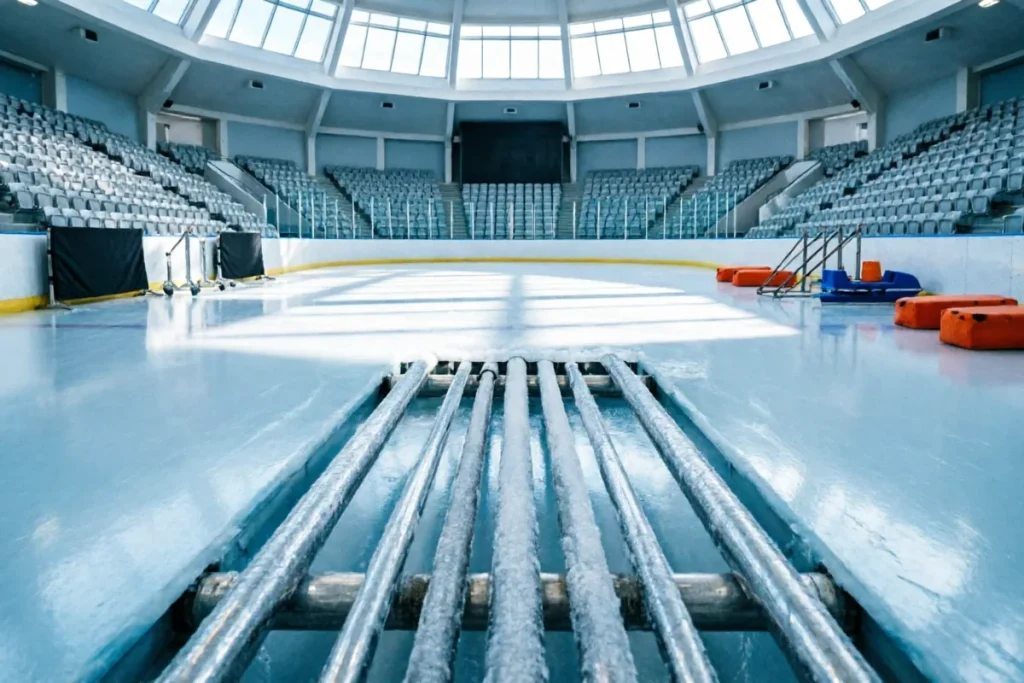
Temperature control affects competition ice by regulating heat removal beneath the slab and adjusting conditions in response to the ice surface, arena air and event. The refrigeration plant cools the slab from below; it is not simply an air-conditioning system for the arena. Because surface hardness depends on both the ice and surrounding air conditions, operators need to monitor and adjust both rather than rely on one fixed setting.
Hockey, figure skating and curling place different demands on the ice, so a temperature setting suited to one discipline cannot automatically be assumed right for another. Ask the venue how it monitors ice-surface temperature and arena air, and how it decides whether to adjust refrigeration or environmental controls for the event.
- Hockey: Ask how the venue assesses surface and air conditions for hockey, rather than assuming its setting is suitable for every sport.
- Figure skating: Check whether staff review and adjust conditions for figure skating separately from hockey.
- Curling: Ask how the venue evaluates the ice for curling and what monitoring informs any adjustment.
What makes an arena suitable for spectators and judges?
An ice arena is competition-ready for spectators and judges when both can see the full rink clearly, and when judging and camera positions do not obstruct those views. Seat count alone cannot establish whether an event layout works: temporary barriers and equipment may block sightlines or reduce the seating available to spectators.
For judges, check that each judging position has an unobstructed view of the performance area. Review camera positions against the same sightlines: equipment placed in front of seats or officials can interfere with the view even when the arena’s permanent seating is suitable.
Check the event layout, not just the seating capacity
A multipurpose rink may have permanent seating, but its usable capacity and visibility can change with temporary barriers and the event configuration. Before assessing an arena, check its published seating plan and the configuration for the specific event; no capacity figure is supplied here, so one should not be inferred from the rink’s seat count.
Which event facilities distinguish a competition arena?
A competition arena is distinguished by event-ready ice access, role-specific facilities and systems for running the competition—not simply by having a rink. Hockey requires functional team benches, penalty boxes, officials’ facilities and rink access, while figure skating needs suitable warm-up space and a practical route from that space to the ice.
Permanent versus temporary provision
Competition operations may also depend on changing rooms, equipment storage, medical provision, timing and scoring systems, and broadcast positions. These requirements differ from the sport-specific spaces: confirm what the arena already provides and what must be brought in or installed for the event.
- Hockey: Check the team benches, penalty boxes, officials’ facilities and access to the rink.
- Figure skating: Check the warm-up area and the route connecting it to the ice.
- Event operations: Confirm provision for changing, equipment storage, medical needs, timing and scoring, and broadcast positions.
- Installation status: Record which facilities are permanent and which require event-time installation; no specific arena or equipment system is identified here.
When is a multipurpose rink not competition-ready?
A multipurpose rink is not competition-ready when its ice is available but the venue lacks the markings, officials’ areas or event equipment required for the specific competition. Public skating or local sport does not establish that those requirements are met: check the event organiser’s specifications and the applicable rulebook.
Check the setup, not just the venue
Readiness depends on the discipline and event setup. A surface prepared for one sport may need substantial work before another can use it, including different markings and equipment; temporary boards or technical installations may also restrict access or change sightlines. These are practical trade-offs to confirm for the actual event, not assumptions to settle from a general venue description.
An advertised capacity is not proof of compliance: it does not confirm the competition layout, officials’ areas or required equipment. Verify each item with the organiser and the rulebook that applies to the event, including whether temporary seating, boards and technical equipment affect access or viewing.
How can organisers check a venue before booking?
Organisers can check whether an ice arena is competition-ready by reviewing its measured rink dimensions, markings plan, operating procedures and event-facility list before signing a booking. Ask for the rink’s actual measurements and a current plan showing the markings, then have the arena confirm in writing that this configuration meets the rules for the specific event.
Ice and arena-air controls need a clear operating plan: ask what conditions are monitored, how they are adjusted during the event, and who makes those changes. Request the monitoring and adjustment procedures, including how the arena handles changes between sessions, rather than relying on a general assurance that the ice will be maintained.
Confirm the layout and responsibilities
Review the seating and camera layouts alongside the locations of officials’ positions, team areas and accessible routes. Ask the venue to identify these on its plans so organisers can check that the arrangements work together before booking.
Get a written facilities schedule that distinguishes what the arena includes from what must be installed temporarily. For each temporary facility, confirm who is responsible for installation; this makes the scope of the booking and the venue’s commitments clear.
Frequently asked questions
Is every ice rink suitable for a winter-sports competition?
No. The rink’s dimensions, markings, ice conditions and event facilities must match the requirements of the specific sport and competition.
Can one ice surface host hockey and figure skating?
Potentially, but the venue must be configured for each discipline, including its markings, surface preparation, officials’ positions and event equipment.
Does a large spectator capacity make an arena competition-ready?
No. Capacity does not confirm compliant ice, clear sightlines, suitable judging positions or the facilities required by the event.
What should an organiser verify first?
Check the measured ice layout against the competition rules, then confirm temperature control, event configuration and which facilities are included.
Key takeaways
- There is no single rink layout that suits every ice sport.
- Ice conditions require monitoring and adjustment, not just refrigeration.
- Spectator capacity matters less if seating blocks views of the ice.
- Confirm permanent and temporary event facilities before booking.