Hockey Skate Heat-Molding: Home Oven or Shop?
Use a skate shop for heat-molding unless your skate manufacturer explicitly approves a home oven. A shop can follow the model’s heating instructions and reduce the risk of damaging the boot.
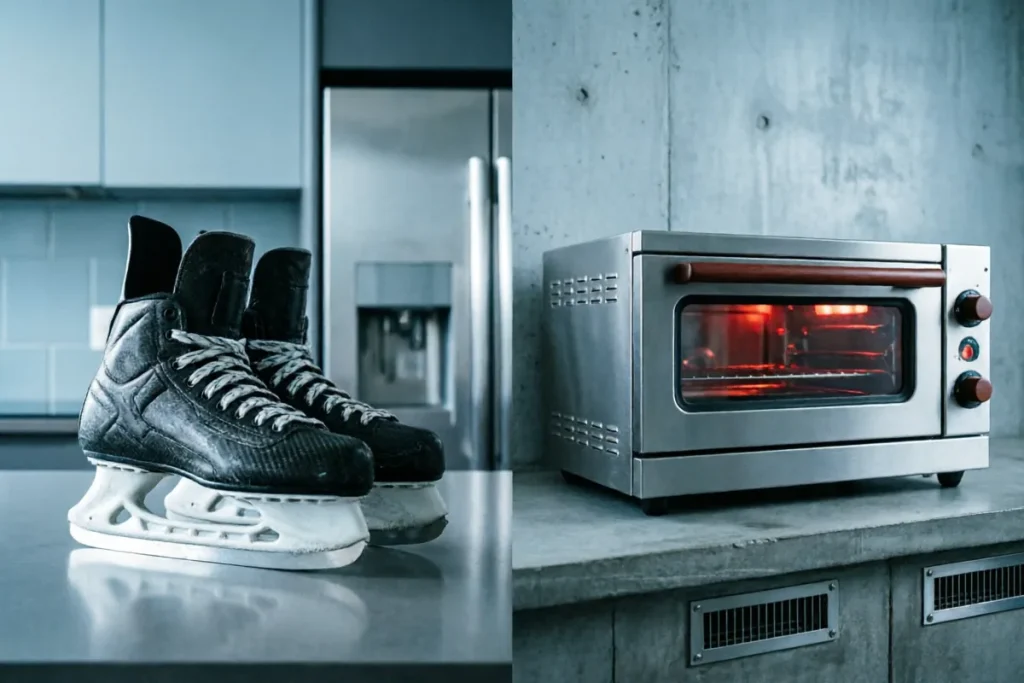
The numbers
Conventional-oven temperature ShoeFitLab describes for home baking
Conventional-oven baking time ShoeFitLab describes
RinkHive’s stated range for professional heat molding
Hockey skate heat-molding softens the boot so it can conform more closely to your foot as it cools. The right temperature and timing depend on the skate, so don’t assume that an oven setting or method used for another model is safe for yours.
If you’re considering doing it at home, check the manufacturer’s instructions first. This article explains how to weigh the convenience of a home oven against the control of a shop—and what to confirm before heating your skates.
| Criterion | Home oven | Professional shop |
|---|---|---|
| Heat control | Conventional oven; overheating risk | Purpose-designed convection oven |
| Damage risk | Permanent damage is possible | Controlled process; still follow model guidance |
| Stated cost | No price stated | $20-40 or often free with purchase |
| Fitting support | No fitter input | Professional fitter can assess fit |
- $299 USD and above General price threshold ShoeFitLab gives for upper-tier Bauer Supreme and CCM Tacks models
How do a home oven and a shop compare?
A skate shop is the safer choice: it uses a convection oven designed for heat molding, while Hejduk Sport warns that a home oven can overheat skates and cause permanent damage.
Temperature control
Shop equipment is made for heat molding, rather than general cooking. ShoeFitLab describes conventional-oven baking at 175–190°F (79–88°C) for 10–15 minutes as possible, but those settings do not remove the overheating risks Hejduk Sport warns about.
- Home oven: Hejduk Sport does not recommend it because overheating can permanently damage the skate.
- Shop convection oven: RinkHive describes shops as using ovens designed specifically for heat molding.
Price and convenience
RinkHive puts shop heat molding at $20-40, though the service may be free with a skate purchase. Check the price and whether molding is included before you buy.
- Shop service: Ask whether the quoted price includes heat molding or whether it is free with your skate purchase.
- Home baking: Avoid treating a stated oven setting and bake time as a guarantee against damage.
When is professional skate molding worth the cost?
Professional skate molding is worth the cost when you want controlled heating and a fitter to assess how the skate fits your foot.
Pro shops use convection ovens designed for skate heat molding, rather than a home oven. That controlled process matters if avoiding heat damage is more important to you than saving the service fee. RinkHive gives a price range of $20-40, though molding is often free when you buy the skates there.
- Before paying: Ask whether heat molding is included with your skate purchase; the shop’s policy determines whether there is a separate charge.
- When fit is uncertain: A fitter can assess how the skate sits on your foot while it is being molded. This is useful when you want a fit check, not just heat applied.
- When blade feel matters: Ask the local pro shop about blade profiling. Profiling is separate from heat molding and may matter if you rely on a specific fit profile.
A shop visit is less compelling if you are only trying to avoid the service fee and already know the skate fits. But if you are concerned about damaging it or want fitter input, check the shop’s molding price and whether it offers the blade profile you use.
Will heat molding work on every skate?
No: heat molding does not work on every hockey skate, and it cannot make the wrong fit profile right. ShoeFitLab says most upper-tier Bauer Supreme and CCM Tacks models, generally $299 USD and above, use heat-moldable foam and quarter-panel materials.
Bauer and CCM skates have different fit profiles. Molding can help the materials conform, but you still need a skate whose shape suits your foot; it is not a substitute for choosing the right fit.
Check the skate before baking
- Exact model: Check the manufacturer’s instructions before arranging a bake. Heat-molding suitability can vary by model.
- Materials and condition: Ask the fitter whether your skate’s materials and current condition make heat molding appropriate.
Those checks matter even for a skate from a model line that commonly uses moldable materials. If you are unsure, ask the fitter to assess the specific skate before it is heated.
What can go wrong, and when should you stop?
Excess heat can permanently damage a hockey skate, so stop if you cannot follow the instructions for its specific model and materials; Hejduk Sport advises against using a home oven.
A home oven is not a universal substitute for the convection ovens shops use for heat molding. Temperature and timing found online are not a safe recipe for every skate: check the model’s own instructions, because construction materials determine what the skate can tolerate. If those instructions are unclear, ask a skate shop rather than guessing.
Limits of repeated baking
ShoeFitLab says a skate has reached the end of its thermoforming life once it stops holding a custom shape after baking. Repeating the molding is not a guaranteed way to restore that shape; stop baking when the skate no longer retains its fit.
- Home oven: Hejduk Sport advises against it because excess heat can cause permanent damage.
- Model instructions: Use the temperature and timing specified for that skate, not an online recipe for another model.
- Shape retention: If the skate stops holding a custom shape after baking, ShoeFitLab’s criterion is that its thermoforming life has ended.
What should you check before booking a skate bake?
Before booking a skate bake, confirm that the shop uses a convection oven designed for skate heat molding, whether the service is included with your purchase or costs $20-40, and whether your specific skate model is heat-moldable.
- Oven: Ask whether the shop uses a skate-molding convection oven. Home ovens are not recommended because overheating can permanently damage skates.
- Price: Check whether molding is free with your skate purchase or charged separately; the service can cost $20-40.
- Model: Give the shop the exact Bauer Supreme or CCM Tacks model you own or plan to buy. Ask whether its materials are heat-moldable rather than assuming every skate in either line can be baked.
- Fit and blade work: If blade profiling or a particular fit profile matters to you, ask whether the shop can advise on both. Bauer and CCM fit differently, and local shop expertise may matter when choosing a profile and planning blade work.
Get the model-specific answer before the appointment, and confirm the price before the shop starts.
Frequently asked questions
Is it safe to bake hockey skates in a home oven?
How much does professional skate heat molding cost?
Can Bauer Supreme and CCM Tacks skates be heat-molded?
Can baking fix skates that have already been broken in?
Key takeaways
- Hejduk Sport warns that a home oven can overheat and permanently damage skates.
- RinkHive lists shop molding at $20-40 or often free with a skate purchase.
- ShoeFitLab identifies upper-tier Bauer Supreme and CCM Tacks models as commonly heat-moldable.
- A skate that no longer holds its custom shape has reached the end of its thermoforming life, according to ShoeFitLab.
Sources
- hejduksport.com — “Professional Skate Heat Molding in Hradec Králové”
- ShelfTrend — “Ice Skates: Accurate Fit Guarantees, Durable Blade Construction & Adjustable Growth Options Win Buyers And Profits”
- allblackhockeysticks.com — “Baking Your Skates: Should You Do It at Home?”
- gear.rinkhive.com — “Breaking In Your Gear the Right Way: Science vs. Old Wives”
- goldenskate.com — “Is it worth getting skates heat molded after a year if they're”