What Do ABEC Ratings Mean for Hockey Skate Bearings?
ABEC ratings measure bearing manufacturing tolerances; they do not directly measure how fast, durable or suitable a hockey skate bearing is. A higher rating means tighter dimensional tolerances, not automatically better performance on the ice.
The numbers
Wheel diameter in Bones Bearings’ speed example
Wheel rotation rate in that example
Travel speed in that example
For hockey skates, ABEC is one detail—not a complete quality grade. Bearing materials, lubrication, sealing and maintenance also affect how a bearing performs, so the rating alone cannot tell you which one to buy.
| Criterion | What it tells you | What it does not tell you |
|---|---|---|
| ABEC grade | Manufacturing precision | Speed, durability or lubricant quality |
| 608 dimensions | Bearing size: 8mm inner diameter, 22mm outer diameter, 7mm width | Materials or maintenance needs |
| Bearing materials | What the bearing is made from | Whether it fits your skate |
| Lubrication and shielding | Construction and care considerations | A guaranteed ABEC grade or speed |
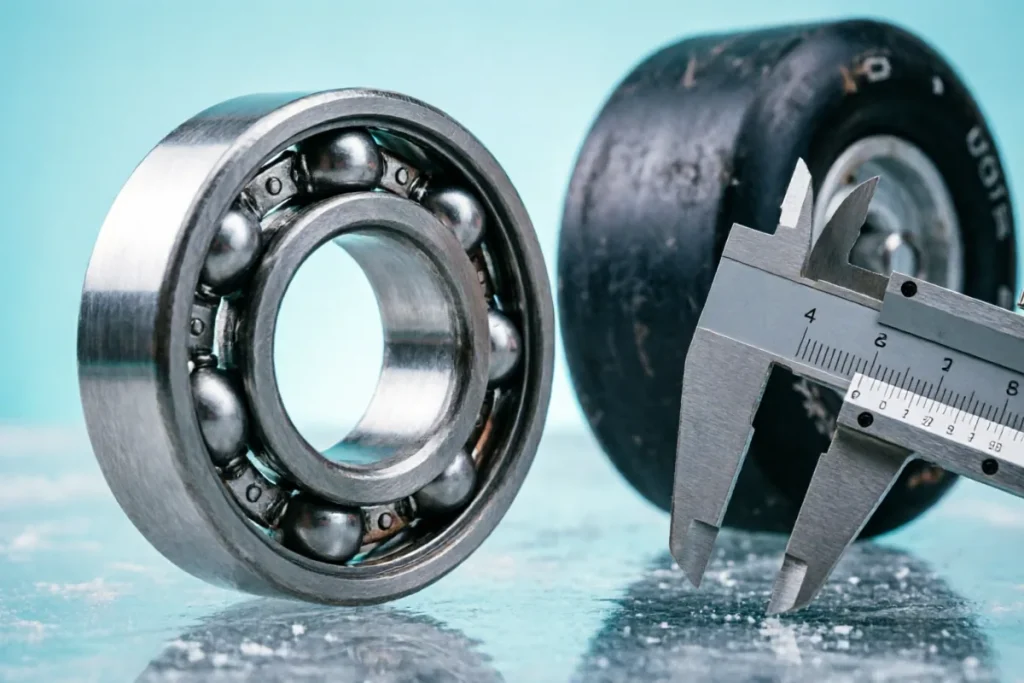
- 8mm × 22mm × 7mm Common 608 bearing dimensions for roller hockey skates
What does an ABEC number measure?
ABEC ratings measure bearing manufacturing precision by describing how closely a bearing’s dimensions meet specified tolerances; they do not fully predict how it performs in a hockey skate.
The ABEC rating system includes grades 1, 3, 5, 7, and 9. A higher grade means tighter tolerances, but the number describes dimensional precision—not every feature that affects a bearing on the ice.
- What the grade tells you: how precisely the bearing is manufactured.
- What it does not specify: the grease, the number of balls, or the quality of the materials.
- What it cannot guarantee: that a bearing with a higher rating will perform better in a hockey skate.
For a practical comparison, treat the ABEC label as one detail on the bearing’s specification, not as a complete measure of hockey performance. Check the other stated features before choosing between bearings with different grades.
Why does a higher ABEC rating not guarantee more speed?
A higher ABEC rating does not guarantee more speed because it describes bearing precision, not whether the lubricant suits skating conditions or the materials will hold up in use.
ABEC tolerances do not rate wheel quality, wheel hardness, frame rigidity or energy transfer. Those factors can shape how fast and efficient a skate feels, so changing the bearing grade alone may make little difference on ice or in roller hockey.
Bones Bearings offers a useful scale check: A skateboard with 54mm wheels turning 20,000 RPM would be traveling about 127 MPH. That example puts the limits of the rating in perspective: a high precision grade is not a promise of useful skating speed.
- Lubricant: ABEC does not establish whether a bearing’s lubricant suits the skating conditions.
- Materials: The rating does not tell you how well the bearing materials will withstand use.
- Skate setup: Wheel quality and hardness, frame rigidity and energy transfer can affect skating feel more than a change in ABEC grade.
What should you check before replacing bearings?
Before replacing hockey skate bearings, check the bearing size, the wheel and axle arrangement, and the specification in your skate or wheel documentation.
Most roller hockey skate bearings follow the 608 size: 8mm inner diameter, 22mm outer diameter, and 7mm width. These dimensions establish the bearing’s physical fit and are common across brands, but they do not identify its materials, shielding, or lubricant.
- Bearing size: Match the 608 dimensions to the bearing you are replacing; size alone does not confirm every other specification.
- Wheel and axle arrangement: Check how the wheel and axle hold the bearing. A bearing must fit that setup, not just match a label.
- Skate or wheel documentation: Verify the replacement specification against the documentation before buying.
- ABEC rating: Treat it as a precision rating, not a complete description of bearing construction or fit.
A higher ABEC rating does not tell you whether the bearing has the materials, shielding, or lubricant you need. Confirm the specification for your skate or wheel rather than choosing a replacement by ABEC number alone.
How do maintenance and durability change the choice?
Maintenance and durability should outweigh ABEC grade when choosing hockey skate bearings: ABEC measures manufacturing precision, not how long a bearing will last under hockey use.
ABEC does not specify a bearing’s grease, materials or shield condition. Those details affect how well it handles dirt and moisture, so a higher rating alone cannot predict durability or protection on the ice.
- Grease: Use a lubricant suited to the bearing’s construction; the grease type is not determined by its ABEC grade.
- Materials and shields: Check the bearing’s materials and the condition of its shields, which help manage exposure to dirt and moisture.
- Maintenance: Keep bearings clean and lubricated, and follow the bearing maker’s maintenance instructions.
Check the bearing’s condition
A rough or noisy bearing needs inspection, not a judgment based on its original ABEC number. The rating describes precision when comparing bearings; it does not show how wear, dirt or moisture has affected one in use. Clean and lubricate it as its maker directs, then assess its condition.
When can choosing a higher ABEC grade be a mistake?
Choosing a higher ABEC grade can be a mistake when the bearing’s fit, materials or lubrication do not suit your hockey skate and how you use it; the number alone does not guarantee better performance or value.
ABEC describes manufacturing precision, not every feature that affects a bearing on ice. Before paying more, check the complete specification:
- Fit: Confirm the bearing matches your skate’s wheel and bearing setup; a higher tolerance grade cannot compensate for a poor fit.
- Materials and construction: Compare the stated materials and bearing design rather than assuming the ABEC number measures them.
- Lubrication and care: Check what lubricant is used and what maintenance the bearing requires for your conditions.
- Rating sequence: Bones Bearings describes ABEC classes as 1, 3, 5, 7 and 9. A listing marked “ABEC 11” falls outside that sequence, so inspect its full specification instead of treating the number as proof of quality.
- Skate-specific testing: Some skate-focused brands use labels such as “Skate Rated” rather than ABEC, pointing to testing for skating conditions instead of a general precision scale.
Compare the bearing as a whole, including how you will care for it. If a listing gives only an ABEC number, look for the missing details before deciding whether the higher price is justified.
Which bearing should a hockey skater choose?
For a hockey skate, choose an ABEC 5, 7 or 9 bearing only after checking that it fits the wheel and suits your budget, construction preferences and maintenance routine; no grade guarantees greater speed or longer life.
ABEC ratings compare manufacturing precision, not every factor that determines how a bearing performs on skates. Grease, materials and bearing construction can differ between products with the same rating, so a higher number alone is not a reliable reason to buy.
- ABEC 5: A balanced option presented for roller hockey; consider it alongside the bearing’s materials, lubrication and price.
- ABEC 7 or 9: Common choices in skating-bearing guides, but neither rating guarantees a faster or more durable bearing.
- 608 fit: Check that the bearing matches the wheel’s required 608 size before comparing ratings.
Once fit is confirmed, compare suitable bearings by materials, lubrication and care requirements. Use ABEC as a precision comparison between otherwise appropriate options, not as a stand-alone performance ranking.
Before buying, read the manufacturer’s full specifications and care instructions, including the stated bearing size, construction and lubrication guidance.
Frequently asked questions
Does ABEC 9 make hockey skate bearings faster than ABEC 5?
What is the standard size for roller hockey skate bearings?
Does ABEC rating tell me how long bearings will last?
Which ABEC grade should I buy for roller hockey?
Key takeaways
- ABEC grades measure precision, not a complete skate-bearing performance rating.
- The ABEC sequence is 1, 3, 5, 7 and 9.
- Most roller hockey bearings use 608 dimensions: 8mm × 22mm × 7mm.
- Bearing materials, lubrication, fit and maintenance matter alongside the rating.
Sources
- bladeville.com — “ABEC skate bearings – what does it mean? – Blog”
- ghostboards.com — “The Ultimate Guide to Skate Bearings – ABEC Ratings, Materials, Spacers & Speed Rings”
- draftwheelchairs.com — “ABEC bearing ratings expalined”
- SkatePro — “Bearings Buying Guide”
- inlinewarehouse.com — “Inline Skate Bearing Buying Guide”