Hockey Skate Sharpening Burrs: What You Feel
A burr on a hockey skate blade feels like a small catch or rough spot as you run a fingernail along its edge. On the ice, it can make one side feel less predictable.
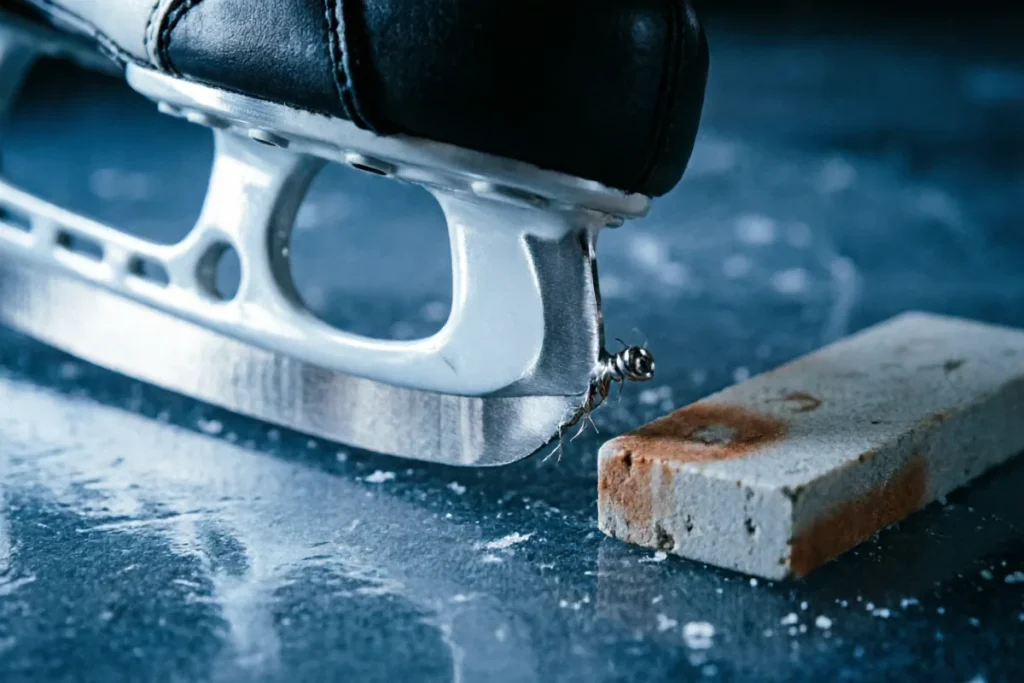
Hockey skate sharpening burrs are tiny raised bits of metal left on an edge after sharpening or contact with another hard surface. They can be hard to see, so a blade may look smooth while still feeling rough to the touch.
Knowing what a burr feels like helps you distinguish it from a dull edge or an uneven sharpening job before your next skate.
| Condition | What you may notice | Appropriate next step |
|---|---|---|
| Small burr after sharpening | Uneven or skidding edge feel | Deburr both sides with a stone |
| Hollow feels too grippy | Edges dig in more than preferred | Discuss a shallower hollow with the sharpener |
| Hollow feels too slippery | Edges do not bite as preferred | Discuss a deeper hollow with the sharpener |
| Visible damage or persistent edge trouble | Edge remains unreliable after deburring | Have a skate sharpener assess the blade |
What is a hockey skate sharpening burr?
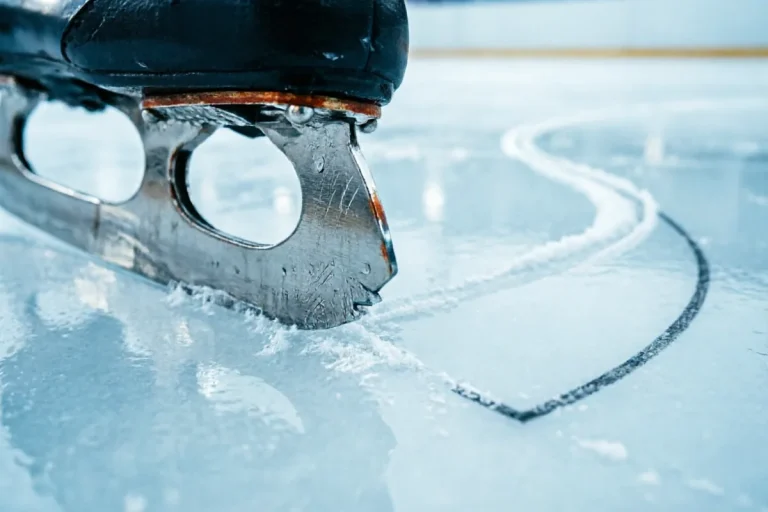
A hockey skate sharpening burr is a small raised lip of metal left along a blade edge after grinding; it is separate from the hollow, the curved channel cut into the blade’s underside.
Sharpening can leave this fine lip on either side of the blade even when the hollow has been cut. The hollow shapes the blade’s underside; the burr is excess material at an edge.
How a burr affects the blade
A burr can stop an edge from meeting the ice cleanly. Instead of biting, the blade may skid, and you can notice the loss of grip during a turn or crossover.
A honing or deburring stone removes the raised metal without changing the hollow. Work it along the blade edge to take off the lip, then check that both sides feel smooth before testing the skates.
How can a burr change your first strides?
A burr can make your first strides feel uneven by interrupting the predictable grip you expect from a freshly sharpened skate. As you push off, notice whether one blade catches or slips differently from the other; that difference is a cue to inspect the edges, not proof of the cause.
During a tight turn or crossover, a blade edge that washes out can lose grip just as you load it. If the skate skids instead of holding its line, the edge feel may be inconsistent; a burr is one possible reason.
A stop that skids instead of shaving snow is another reason to check the blades. It does not, by itself, show that a burr is responsible: the symptom tells you to inspect, not to assume the sharpening must be repeated.
Compare before changing the sharpening
- Left and right skate: Compare the push-off feel on both blades. A difference on one skate can help narrow down where the problem lies.
- Both edges on each blade: Check whether the inside and outside edges feel consistent. A burr on one edge may make the response uneven.
- Turns, crossovers and stops: Notice which movement produces the slip. These checks reveal when grip changes, but none alone identifies a burr.
Compare both skates and both edges before asking for another sharpening. If the uneven feel remains, have the edges checked rather than treating a skid as a diagnosis.
How does hollow choice affect the edge feel?
The hollow’s radius determines how strongly a hockey skate’s edges bite: a smaller radius creates a deeper channel and more pronounced edges, while a larger radius creates a shallower channel with less resistance.
The hollow is the concave channel ground into the blade between its two edges. With a smaller radius, the edges dig farther into the ice; with a larger radius, the blade meets less resistance and glides more freely. Choose based on the edge feel you want, rather than treating one hollow as right for every player.
- Smaller radius: deeper hollow, stronger bite and more resistance.
- Larger radius: shallower hollow, less resistance and more glide.
Hollow choice and deburring
Deburring removes a raised lip left on an edge after sharpening. It can smooth the edge feel, but it does not reshape the hollow or change its radius; a change in hollow requires sharpening.
ProStride Hockey USA lists junior players aged 11–14 with a recommended ROH of 9/16″ – 3/4″. That recommendation is for this age group, whose players are developing speed and agility and building basic edge awareness—not a universal setting. If you are choosing a hollow, consider the player’s balance and preferred grip as well as glide.
How do you deburr without removing a sound edge?
Use a deburring stone or rubber stone on both sides of the blade after sharpening, before testing the edges, and guide it over the raised burr without grinding the working edge or changing the hollow.
Keep the stone controlled and make only the contact needed to clear the burr. The hollow is the curved groove between the blade’s edges; altering it can change how those edges engage with the ice. Deburring removes the raised metal left by sharpening, not the shape of the sharpened blade.
Check the edges before you skate
After deburring, check that both edges feel level and consistent. A honing stone can maintain an edge between full sharpenings, but it cannot correct a hollow that was cut incorrectly.
If the blade still skids, ask the sharpener to inspect the sharpening rather than repeatedly honing it. Persistent skidding can point to a problem that honing alone will not fix.
When is a honing stone not enough?
A honing stone is not enough when a skate blade has a visible nick, damage or uneven edge, or when the edge still feels unreliable after careful deburring. Those are not routine burrs: stop removing metal at home and have a skate sharpener assess the blade.
A burr is a small imperfection on an otherwise serviceable edge. A honing stone can remove that imperfection, but it cannot restore a damaged edge or correct an unsuitable hollow. A nick or uneven edge may need sharpening or repair; the right remedy depends on what the sharpener finds.
When to get the blade assessed
- Visible damage or unevenness: Don’t keep honing in an attempt to erase a nick or level a damaged edge. Ask a skate sharpener whether the blade needs sharpening or repair.
- Unreliable edge after deburring: Stop removing metal at home. Have the blade assessed, including whether its hollow—the groove between the edges—suits your needs.
Bladz Skate Shop has 9 locations throughout Alberta, Ontario and BC. Check a service provider’s current location and repair options before travelling; a honing stone is for minor edge imperfections, not blade repair or hollow correction.
What should you check before changing the setup?
Before changing a hockey skate setup, separate a raised burr from a hollow preference: deburring removes the lip on the blade edge, while the hollow determines how the edges meet the ice.
A honing stone can address a burr, but it does not reshape the hollow. Once the burr is removed, assess the edge feel on the ice. If the blade still feels consistently too grippy or too slippery, discuss the hollow with your sharpener rather than using a stone to compensate.
Keep the checks separate
- Burr: Check for a raised lip on the blade edge and have it deburred before judging the sharpening.
- Hollow: If the clean edges still feel wrong on the ice, ask the sharpener about the hollow. Keep the sharpening setup consistent while assessing a change so you can tell whether the difference comes from the burr or the hollow.
- Lace fit: ProStride Hockey USA lists skate lace sizes of 72”, 84”, 96”, 110”, and 120”. Lace length is a separate fit check, not a remedy for edge feel.
Check the lace length separately from the blade’s edge feel; changing laces will not alter the hollow or remove a burr.
Frequently asked questions
Can a burr make new skates feel dull?
Does a honing stone change the hollow?
Should you deburr both sides after sharpening?
When should you stop honing at home?
Key takeaways
- A burr is a raised imperfection, not a change to the blade’s hollow.
- Deburr both sides after sharpening before testing edge feel.
- A smaller hollow radius means a deeper hollow; a larger radius means a shallower one.
- Persistent skid or visible damage calls for a sharpener, not more home honing.
Sources
- Better Hockey US — “Hockey Skate Sharpening Guide: Hollow & Profile | Better Hockey”
- Tydan Performance Blades — “Skate Sharpening”
- themadspinner.com — “Ice Skate Sharpening Guide for Figure Skaters – The Mad Spinner”
- newtohockey.com — “Beginners Guide to Skate Sharpening”
- sparxhockey.com — “Deburring Hockey Skates Guide – What Stones To Use and”