Indoor vs. Outdoor Ice: What Weather Changes
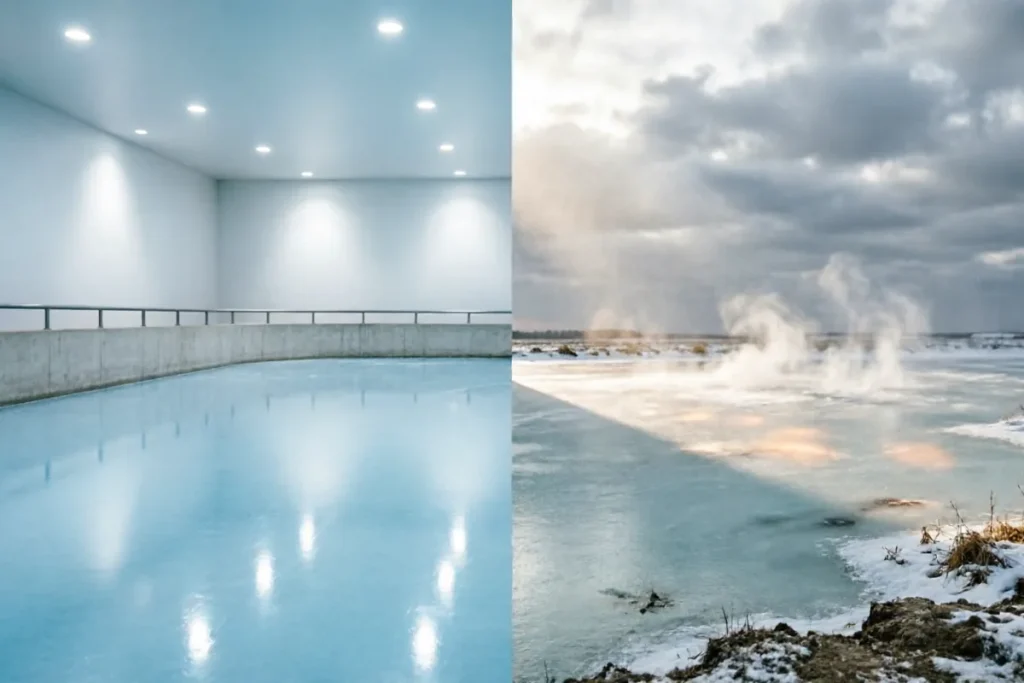
Indoor ice stays more consistent because rink operators control the temperature and humidity; outdoor ice changes with the weather. Temperature, sun, wind and precipitation can alter its hardness, surface and skating conditions.
The numbers
Ice temperature range associated with harder ice preferred by hockey players
Ice temperature range associated with softer ice offering better grip for figure skating
Outdoor air-temperature condition given for forming a solid ice surface
That difference affects how the ice feels under your blades. A rink can maintain a stable surface, while a cold spell, thaw or snowfall can make outdoor ice uneven or soft. Understanding what weather changes helps you judge conditions before you skate.
| Factor | Indoor ice | Outdoor ice |
|---|---|---|
| Temperature | Managed as part of rink conditions | Changes with local weather and can vary with sun exposure |
| Humidity | Can be controlled; high humidity can cause condensation | Exposed to outdoor air conditions |
| Surface warmth | Skater friction can warm used patches | Sun and skater friction can warm the surface |
| Consistency | More controlled conditions support a steadier surface | Weather can change surface feel during a session |
How does indoor ice differ from outdoor ice?
Indoor ice differs from outdoor ice because rink operators can manage the indoor environment, including humidity, while outdoor ice is exposed to changing air temperature and weather. That control can make the indoor surface more consistent, though it does not make it immune to change.
- Indoor rink: Humidity and rink conditions can be managed to support ice quality.
- Outdoor rink: Air temperature and weather can change during a skating session, shifting conditions at the surface.
The comparison is not simply cold versus warm. Solar gain can warm outdoor ice, and skaters’ friction adds heat at the surface; the ice responds to those local conditions, not just the air temperature. Outdoors, changing weather can alter the surface as you skate, while indoor management helps limit those shifts.
What temperature range changes the feel of rink ice?
Rink ice feels harder around 22°F to 24°F (-6°C to -4°C), a range hockey players tend to prefer; slightly warmer ice feels softer and offers figure skaters better grip.
- Hockey: Around 22°F to 24°F (-6°C to -4°C), the ice is described as harder.
- Figure skating: Around 24°F to 26°F (-4°C to -3°C), the ice is described as softer, with better grip.
The ranges meet at 24°F (-4°C). They describe preferences, not a fixed dividing line between hockey and figure skating, so the same temperature sits within both ranges.
Why does humidity matter on indoor ice?
Humidity matters on indoor ice because moist air can condense on the surface, changing its quality. Lower humidity helps keep the ice dry, while managing moisture is part of maintaining the rink.
Air temperature alone cannot explain why indoor ice feels different from one visit to another. If the surface seems damp or less consistent, humidity is another condition to consider alongside temperature; the two affect the ice in different ways.
Why does direct sun make outdoor ice less predictable?
Direct sunlight can warm outdoor ice even when the air stays cold, so exposed and shaded patches may behave differently under skaters.
The New York Times reported that Central Park reached 100 degrees by 2 p.m., tying its daily record set in 1966. It also reported LaGuardia Airport reached 104 degrees, surpassing its daily high of 101 from 1966. These were heat-wave readings, not temperatures that define a safe skating surface.
Air temperature alone cannot tell you whether outdoor ice is safe. Check the ice itself and the local rink notice, especially where sunlight reaches the surface.
How does skating itself affect the surface?
Skating friction warms the ice locally, so heavily used patches can feel different from areas that see fewer passes. Hardness and smoothness also affect how a blade responds: ice suited to hockey may not offer the grip a figure skater prefers.
Before you skate, check the surface for ruts, rough patches and wet-looking areas. These can change how your blades travel across the ice; outdoors, weather can add further variation from one patch to another.
When is outdoor ice not safe to skate?
Outdoor ice is not safe to skate on when the rink operator has not confirmed it is open, or when changing weather or local surface conditions make the ice uncertain. Air temperature alone cannot establish that a pond or patch is safe.
Outdoor rinks need air temperatures below 25°F (-4°C) for at least 72 consecutive hours to form a solid ice surface. That is a formation condition, not a personal safety guarantee: sunlight and changing weather can affect the ice after it forms.
- Frozen-looking pond or patch: Do not treat its appearance or the air temperature as proof of safety.
- Outdoor rink: Check the operator’s current notice before skating, and stay off the ice if safety has not been confirmed.
How can you check local weather history?
Check NASA Earthdata’s Daymet dataset for local weather history: it provides gridded daily surface-weather data for Continental North America and Hawaii from January 1, 1980, through December 31 (or December 30 in leap years) of the most recent full calendar year.
Daymet can help you examine past weather near an outdoor rink, but it describes daily conditions across a grid, not the state of a specific ice surface in real time. Weather history cannot certify that a particular patch is safe to skate on.
Before skating, check current rink or ice-safety notices for the location you plan to use.
Sources
- weatherapi.com — “Weather in Global”
- Clime Blog — “Weather Conditions for Ice Skating: A Comprehensive Guide”
- Climate Central — “Milano Cortina 2026: Warming Winter Olympics”
- antarcticglaciers.org — “Ice core basics”
- Preprints.org — “Outdoor Ice Rinks in Ontario, Canada – A Model for Ice Water Equivalent and Operational Duration to Evaluate Changing Climate[v1]”