How Do Rink Operators Check Ice Thickness?
Rink operators check ice thickness by drilling small holes and measuring the ice with a gauge. They repeat the checks in different areas because thickness can vary across the surface.
The numbers
Ice thickness described as “excellent” for hockey by the International Ice Hockey Federation guidelines
Ice thickness described as “good” for hockey by the International Ice Hockey Federation guidelines
North American ice arena managers whose expert survey responses were combined with existing literature
The reading is only part of the picture: operators also need to know whether the ice is sound and consistent, not just thick at one test point. How often they check and what thickness they require depend on the rink and its use, so ask the operator about its inspection practice if you need a specific answer.
| Use or context | Thickness guidance | Practical distinction |
|---|---|---|
| Ice hockey | 30 to 35 mm: “excellent” | International Ice Hockey Federation guideline |
| Ice hockey | 36 to 45 mm: “good” | International Ice Hockey Federation guideline |
| Figure skating | Thicker than hockey | Sport-specific ice requirement |
| Curling | Thinner than hockey and figure skating | Sport-specific ice requirement |
| Natural lake or pond ice | Rink targets do not establish safety | Condition and ice type matter |
- 14 U.S. states and 8 Canadian provinces Places represented in the arena study’s survey responses
Why is a single test hole not enough?
A single test hole is not enough because it measures ice depth at only one spot, while thickness can vary across the rink. Operators need readings from multiple points to see that variation.
Measure and map
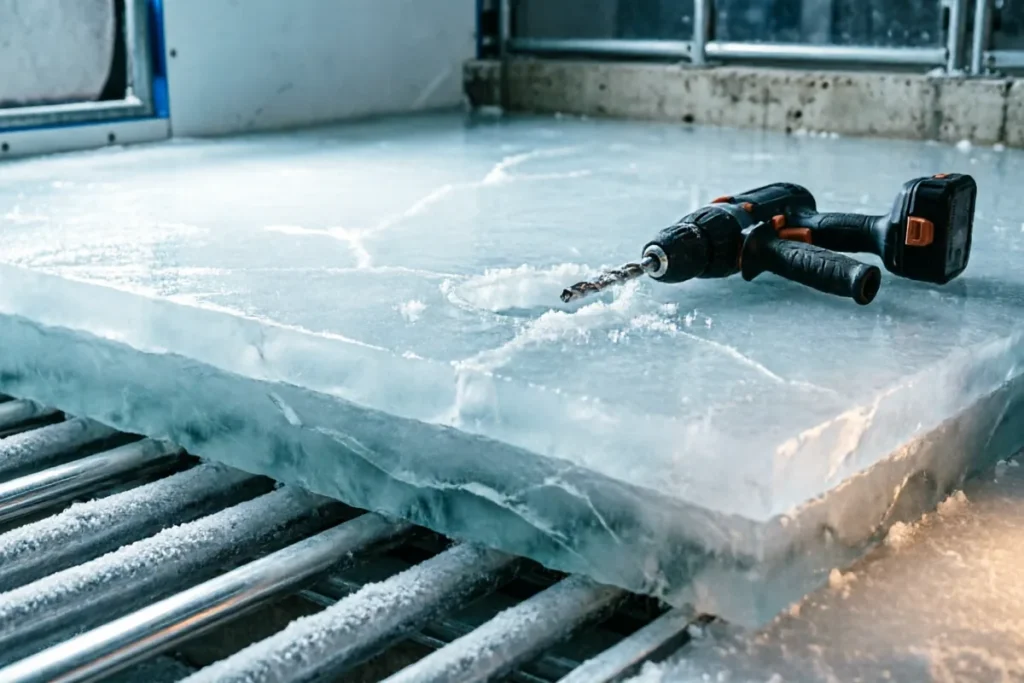
An ice chisel, auger or cordless drill can make a hole for a direct thickness measurement. The tool shows how deep the ice is at that location; it does not establish the depth elsewhere on the surface.
Record where each reading is taken. When operators repeat checks at the same locations, they can compare measurements over time and see whether thickness has changed in a particular part of the rink. Without location records, a new reading may not be comparable with an earlier one.
Check condition as well as depth
A thickness reading describes depth, not the full condition of the ice. It cannot, by itself, prove that the surface is suitable for every use.
- Ice depth: measured directly through a hole made with a chisel, auger or cordless drill.
- Ice condition: a separate consideration that a depth measurement alone does not establish.
- Use: suitability depends on more than a single thickness reading, so operators should not treat one measurement as a universal clearance.
Why can a thickness reading change across the rink?
Ice thickness readings can change across a rink because temperature, humidity and ice-making practices affect the ice’s surface and depth, and conditions may differ by location.
The study included responses from 14 U.S. states and 8 Canadian provinces, covering climates from the Pacific Northwest to desert, prairie, temperate and maritime regions. Those varied operating environments mean one rink’s settings or measurements are not a universal template.
When readings differ, compare where each measurement was taken and the local operating conditions. A single rink-wide number can conceal location-specific variation; check the relevant area rather than assuming one reading describes the whole surface.
Why is one ice-thickness target not right for every sport?
One ice-thickness target does not suit every sport because hockey, figure skating and curling use different ice conditions.
Match the target to the sport.
The International Ice Hockey Federation guidelines classify 30 to 35 mm as “excellent” and 36 to 45 mm as “good” for hockey. Figure skating calls for thicker ice than hockey, while curling uses thinner ice, so operators need to set the target for the sport being played.
- Hockey: the International Ice Hockey Federation’s “excellent” and “good” thickness ranges provide the sport-specific benchmarks.
- Figure skating: the ice target is thicker than hockey’s.
- Curling: the ice target is thinner than hockey’s.
A study combined expert survey responses from 55 North American ice arena managers with existing literature to identify best practices for managing ice conditions. Its survey included 35 experts from Canada and 20 from the United States, spanning diverse climate zones.
What goes wrong when operators chase thickness alone?
Rink operators who chase thickness alone can build ice that suits one sport poorly, miss thin patches elsewhere, and overlook the conditions causing the surface to change.
Ice depth is a sport-specific operating choice, not a universal maximum. The International Ice Hockey Federation guidelines describe 30 to 35 mm as “excellent” and 36 to 45 mm as “good” for hockey; figure skating calls for ice at the higher end of the range, while curling uses the thinnest ice. Adding ice without regard to the sport can therefore move a rink away from its intended conditions.
A hole made with an ice chisel, auger or cordless drill gives a direct depth reading only at that spot. If operators repeatedly measure one point, local variation elsewhere can go unnoticed. Check the surface condition too, and use the rink’s operating criteria to decide whether the measured depth is suitable.
Temperature and humidity also affect rink conditions. Thickness alone cannot show why the ice has changed, so operators need to manage those factors alongside depth and assess the surface rather than relying on a measurement in isolation.
When do standard rink checks not apply?
Standard rink checks do not apply when the ice is a frozen lake or pond: indoor hockey criteria are not general safety rules for natural ice.
Massachusetts ice-safety guidance covers clear, blue ice on lakes and ponds. It warns that white or snow ice is about half as strong as new clear ice. That difference matters even when two spots have the same measured thickness.
Natural ice can change in thickness and condition across a lake, so a measurement at one point cannot establish that the whole surface is safe.
- Indoor rink: Follow the facility’s criteria for its sport; hockey, figure skating and curling have different ice requirements.
- Frozen lake or pond: Use local ice-safety guidance and assess the ice separately, including its type and condition.
For natural ice, check the applicable local guidance before going out, and do not treat a rink measurement as a safety assessment.
Frequently asked questions
How do rink operators measure ice thickness?
What thickness is considered excellent for hockey?
Does figure skating use the same ice thickness as hockey?
Can rink measurements be used to judge lake ice?
Sources
- WBS Penguins — “Importance of Ice Thickness in Ice Hockey”
- lmcd.org — “Ice Safety Reminders – LMCD”
- ohiodnr.gov — “Ice Thickness Guidelines”
- Mass.gov — “Ice strength and safety”
- Scientific Reports — “Arena ice quality and perspectives on optimizing performance and addressing emerging challenges”