Why Rink Ice Gets Soft Near the Boards
Rink ice gets soft near the boards because warmth from the rink structure and nearby air melts the surface faster there.
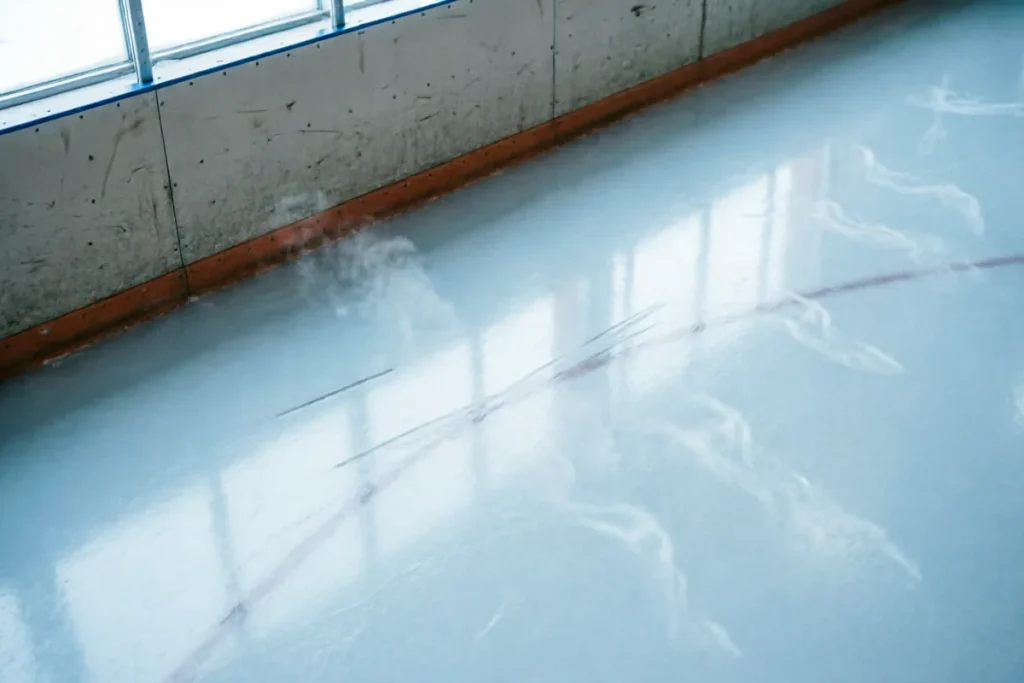
Boards also interrupt airflow, so temperature and ice conditions can vary around the rink. If the edges feel slower or leave deeper skate marks, the cause may be local heat rather than a problem across the whole sheet.
| Condition | What it can indicate | Practical response |
|---|---|---|
| Leaves or pine needles in unfrozen water | Sun-warmed debris and uneven freezing | Remove debris before flooding or resurfacing |
| Recurring soft area near boards | Possible local airflow or refrigeration pattern | Ask rink staff to inspect the same location |
| Backyard low spot | Ground slope or early flooding mistakes | Build up gradually with thin water layers |
| Bulging walls or squared corners | Poor containment or disrupted puck flow | Address rink construction rather than only resurfacing |
| Uneven surface temperature | Freezing may vary across the ice | Consider thermic conductive paint |
Why does ice near the boards become soft?
Ice near the boards softens when freeze/thaw cycles, debris, airflow and refrigeration leave the surface freezing unevenly; the patch’s size and position depend on rink conditions.
Weather and debris
Freeze/thaw cycles can make patches freeze at different rates, especially where water depth varies. Leaves and pine needles in unfrozen water absorb the sun’s heat and can contribute to uneven freezing.
Airflow and refrigeration patterns also affect how consistently a rink surface freezes. A soft spot’s location and size therefore depend on the rink, rather than following a fixed pattern. The International Ice Hockey Federation has 74 member associations.
Traffic and surface condition
Repeated traffic over a soft patch can make the ice feel less predictable underfoot or under a blade. Check whether the softness is confined to one local spot or appears across a wider area: a single patch points to a local surface variation, while a broader pattern warrants attention to overall ice temperature and freezing conditions.
How can you tell a soft patch from a low spot?
You can distinguish a soft patch from a low spot by checking whether your blade responds differently there and comparing the patch with nearby ice: softness changes the blade’s feel, while a low spot is a difference in ice level.
Roughness alone is not proof of soft ice. A blade may chatter over a rough patch without sinking or losing support; compare the same stroke on adjacent ice before deciding what you are feeling.
On a backyard rink, ground slope and mistakes during early flooding can leave the ice uneven. Bulging walls or squared corners can also disrupt puck flow and accompany uneven areas, so check the rink’s shape as well as the surface.
When to ask rink staff
The International Ice Hockey Federation’s guide says it is possible to construct an ice rink anywhere in the world. That does not mean every rink has the same surface conditions: a broad soft area, or one that keeps returning, merits an assessment of the surface and refrigeration conditions.
Ask rink staff to investigate a recurring or widespread patch rather than treating it as a single scrape or rut. For a backyard rink, correct low spots gradually with thin layers of water; do not assume a scrape will fix a difference in ice level.
How should you skate across a soft spot?
Skate across a soft spot near the boards with bent knees and your weight centred over your skates, so a sudden change in blade grip is less likely to pull you upright.
On the soft patch, keep your route smooth: avoid a hard edge change, an abrupt stop or a tight turn. If the traffic pattern allows, take a wider line around it rather than making a sharp correction at the last moment.
A crowded corner is not a safe place to gain speed or cut across another skater’s path. Hold your line and leave enough room to pass without forcing someone else to move suddenly.
Tell rink staff where the soft ice is and point to a fixed landmark, such as a board corner. A clear location helps staff inspect the same section rather than search the whole rink.
What can rink operators do to reduce uneven freezing?
Rink operators can reduce soft, uneven ice by clearing debris before flooding, using thermic conductive paint where appropriate, and checking for recurring airflow or refrigeration patterns before changing resurfacing routines.
Commercial surfaces
On commercial ice, leaves and pine needles can absorb heat from sunlight while water is still unfrozen, disrupting the freeze. Remove them before flooding or resurfacing.
Thermic conductive paint can help maintain a more consistent temperature across the ice surface and promote more uniform freezing. Before altering resurfacing practices, check whether airflow or refrigeration is creating the same soft pattern near the boards repeatedly.
- Debris: Clear leaves and pine needles before adding water.
- Temperature: Consider thermic conductive paint to support more even freezing.
- Recurring soft spots: Check airflow and refrigeration patterns before changing resurfacing practices.
Backyard maintenance
For backyard rinks, correct low areas gradually with thin layers of water rather than trying to fill them in one heavy flood. A large flood can freeze unevenly, leaving the low spot difficult to correct; apply another thin layer only after the previous one has frozen.
When do these fixes not solve the problem?
These fixes do not solve the problem when the cause is structural, when a busy rink needs an immediate repair, or when a soft patch keeps returning without a diagnosis.
- Thermic conductive paint helps keep ice temperatures consistent, but it cannot correct a sloped base, water escaping past the boards or boards that bulge inward.
- Thin-layer flooding can raise low spots on a backyard rink gradually. It is not a quick repair for an active soft patch on a busy rink; the underlying freezing conditions still need attention.
- A recurring patch in the same place is a reason to check local freezing conditions, airflow and traffic before resurfacing again. Repeated flooding without finding the cause can leave the problem in place.
Match the repair to the rink
The International Ice Hockey Federation guide says rink construction is possible anywhere in the world, and the federation has 74 member associations. Those facts describe the reach of rink construction, not whether one maintenance method will suit every rink.
For a returning soft spot, check whether water is contained at that section of boards, whether the base slopes there, and whether airflow or rink traffic differs from nearby ice.
Frequently asked questions
How do you repair a low spot on a backyard rink?
Key takeaways
- Leaves and pine needles can contribute to uneven freezing when they sit in unfrozen water.
- Thermic conductive paint supports more consistent surface temperatures but does not repair structural or drainage problems.
- Avoid hard turns and stops on a soft patch; report its location to rink staff.
- Backyard low spots should be corrected gradually with thin water layers.
Sources
- HTG Architects — “Industry Expert Suggestions on How to Properly Maintain Your Arena's Ice Rink”
- YardRink — “How to Build a Backyard Ice Rink (Read Before Committing)”
- ieg.co — “How to Fix Uneven Ice and Low Spots on a Backyard Rink”
- Glice — “What Is Synthetic Ice? How It Works and What Makes It Good”
- omha.net — “The Do's and Don'ts of Backyard Rink Building”