How to Play Curling: Rules and Scoring
To play curling, teams slide stones across the ice toward a target called the house, aiming to finish closer to its centre than their opponents. Players take turns delivering stones and can sweep the ice to influence how far and how straight a stone travels; scoring is based on the stones closest to the centre after an end.
The basic idea is simple, but strategy comes from deciding where to place each stone and when to clear an opponent’s from play. This guide to curling rules and scoring explains how turns, sweeping and the house fit together, and how those choices shape each end.
| Stone position or situation | Scoring effect |
|---|---|
| Touches or lies within the house | Eligible for scoring |
| Closer to the tee than the opponent’s nearest stone | Scores one point for the team |
| In the house but farther from the tee than the opponent’s nearest stone | Does not score |
| Outside the rings | Cannot score; may act as a guard |
| No stone touches the house | Blank end; no points |
What are the house, tee and rings?
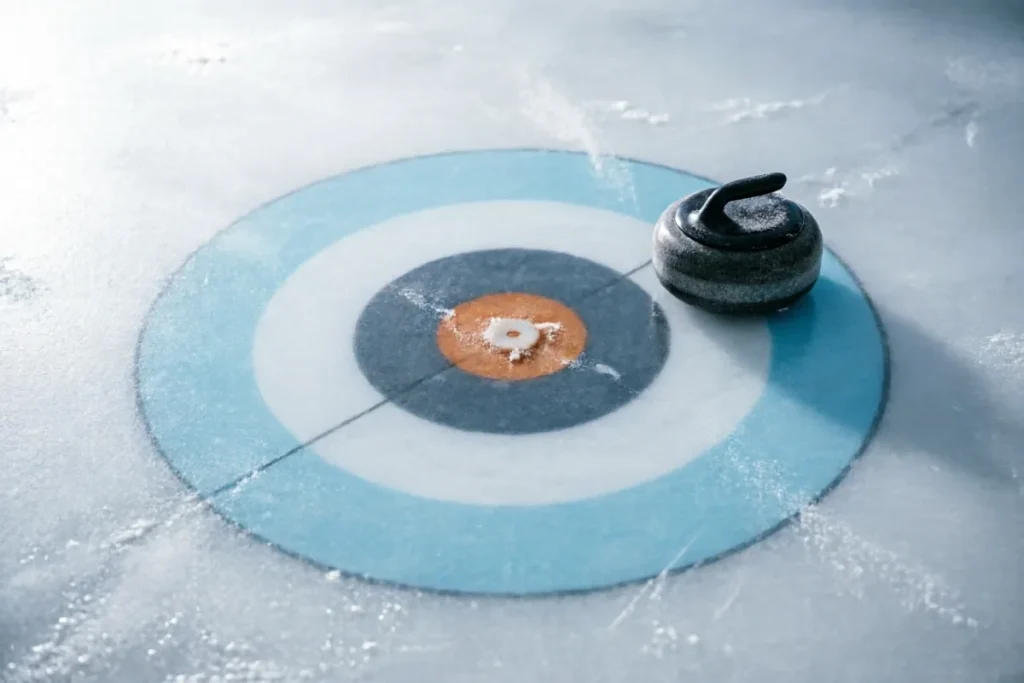
The house is curling’s target area of concentric rings, and the tee—or pin—is its centre. For scoring, the house is the 12-foot zone, equivalent to 3.7 metres; a stone qualifies if any part of its edge touches a ring.
A stone can count even when it only just overlaps the outer ring. Judging that edge can be tricky because a curling stone’s underside is rounded, so its contact with the ice may not make the boundary obvious.
The tee is the reference point for deciding which team scores: compare the eligible stones’ distance from the centre. A team scores for each of its stones that is closer to the tee than the opponent’s nearest eligible stone.
How does a curling end work?
A curling end is one complete round in which both teams deliver their stones, and its score is decided after all 16 stones have been thrown. Teams take turns sending stones towards the house; the following end is played in the opposite direction.
A stone must be released before the hog line to remain in play. Once all 16 deliveries are complete, only stones in the house—within or touching the edge of its 12-foot zone—can score: the team with the stone closest to the tee earns one point for each of its stones that is closer to the tee than the opponent’s nearest stone.
Three useful shot names
- Draw: A shot intended to settle a stone in the house.
- Guard: A stone placed in front of the house or a target stone to protect it.
- Takeout: A shot aimed at knocking another stone away.
How are points awarded in curling?
Counting the scoring stones
Curling points go to the team whose stone lies closest to the tee, the centre of the house, and are counted only for that team’s stones closer to the tee than the opponent’s nearest stone. A stone must be in or touching the house to qualify; one outside the rings cannot score.
For each end, compare the teams’ eligible stones with the opponent’s closest stone. If one team has several stones closer to the tee than that opposing stone, each of those stones earns one point; the other team scores nothing in that end.
- Stone in or touching the house: eligible to score.
- Stone outside the house: cannot earn a point, even if it is the closest stone on the sheet.
- Closest stones from opposing teams: the team with the single nearest stone scores, counting its other stones only if they are also closer than the opponent’s nearest.
- No stone touching the house: the end is blanked, so neither team scores.
How long is a game, and how is the winner decided?
A standard curling game lasts 10 ends, and the team with the higher cumulative score when those ends are complete wins. Points from each end are added to the teams’ running totals; if the totals are tied after the 10th end, play continues with extra ends until one team leads.
How an end’s score affects the result
In each end, scoring depends on the stones’ final positions in the house, not on how many stones a team delivered there. Only stones touching the house are eligible: the team whose stone is closest to the tee scores one point for each of its stones that is closer to the tee than the opponent’s nearest stone.
Because only one team can score in an end, delivering more stones into the house does not automatically mean earning more points. If neither team has a stone touching the house, the end is blank and adds no points to either running total.
What common mistakes can change the score?
In curling, a score changes when you misjudge which stones qualify and which team has the closest qualifying stone: count only stones touching the house, then compare their distance to the tee with the opponent’s closest stone.
Eligibility is not the same as scoring.
- Counting stones: A team does not score for every stone in the house. It earns one point for each eligible stone closer to the tee than the opposing team’s closest eligible stone.
- Touching the outer ring: A stone need not sit fully inside the house. Even a stone that only touches the edge of the ring is eligible for scoring.
- Outside the rings: A stone beyond the house may act as a guard, protecting stones nearer the tee, but it cannot score while it remains outside the rings.
- Blank end: If no stone from either team touches the house, neither team scores in that end. The end adds zero points; it is not a win for either side.
Apply these checks after all stones in the end have been delivered: first exclude stones that do not touch the house, then compare the remaining stones’ positions relative to the tee. This prevents a guard from being counted as a point and avoids awarding points merely because several stones belong to the same team.
How can a beginner read the score after an end?
After a curling end, identify the stone nearest the tee, the centre of the house: its team is the only team that can score. Then count that team’s stones in the house that are closer to the tee than the opponents’ nearest stone.
- Find the scoring team. Compare the stones touching the house and locate the one closest to the tee. The team that delivered it scores; the other team cannot score in that end.
- Count eligible stones. Count the scoring team’s other stones in the house only if each is nearer to the tee than the opponent’s closest stone. A stone qualifies for scoring if it touches the house, including its edge; guards outside the house do not count, even if they helped protect a scoring stone.
- Update the game total. Add the end’s points to the team’s running score. If no stone touches the house, the end is blank and adds no points.
After the tenth end
Curling games are played over 10 ends. Once the tenth-end score is added, check the totals: a tie means the teams play extra ends until the tie is broken. A stone’s position relative to the tee determines which stones count; stones outside the house are not scoring stones.
The short version
- The house is the 12-foot (3.7 m) scoring zone around the tee.
- Touching the ring is enough for a stone to qualify.
- Only stones closer to the tee than the opponent’s nearest stone score.
- A standard game lasts 10 ends; a tie leads to extra ends.
Common questions
How many points can a team score in one end?
A team scores one point for each of its stones in the house that is closer to the tee than the opponent’s nearest stone. The supplied rules do not set a maximum number.
Does a stone have to be completely inside the house?
No. It qualifies if it lies within the twelve-foot zone or any part of its edge touches the ring.
What happens if neither team has a stone in the house?
The end is blanked: no points are awarded, and the running score does not change.
What happens when a 10-end game is tied?
The teams play extra ends until the tie is broken.
Can a guard score a point?
Not while it stops outside the house. A guard protects stones or a target, but only stones touching the house are eligible to score.
Sources
- curlingbasics.com — “scoring – Curling Basics – curling explained; excellent for beginners”
- siliconvalleycurling.com — “Curling Basics – Silicon Valley Curling Club”
- USA CURLING — “Intro to Curling”
- cedarrapidscurling.com — “Cedar Rapids Curling Club – Curling Basics”
- espn.com — “What is curling? Olympic rules, scoring, more – ESPN”