What Jump Harnesses Teach—and What They Cannot
A jump harness teaches you to feel takeoff, rotation and landing timing with support; it cannot teach you to control a jump unaided. It is a training aid, not proof that a skill is ready for the ice.
The numbers
Minimum age to compete raised by the International Skating Union
Year of the Olympics referenced in the age-rule context
By reducing the risk of a fall, a harness can let a skater practise a movement and notice how body position changes in the air. But the support also changes the sensation of balance and control. What feels secure on a harness may not transfer directly to an unsupported jump.
Understanding that difference helps you use jump harnesses for what they can teach—and recognise when progress needs to be checked without them.
| Training option | What it changes | Best suited to | What it cannot establish |
|---|---|---|---|
| Jump harness | Adds physical support through a cable system | Rehearsing difficult jump movements and air position | Independent timing or consistency |
| Dartfish video review | Replays and overlays jump footage | Examining visible positions and comparing attempts | How the skater performs with physical support |
| Unaided practice | Tests the jump without harness assistance | Checking transfer, timing and landing control | It does not provide the harness’s physical support |
What does a figure skating jump harness support?
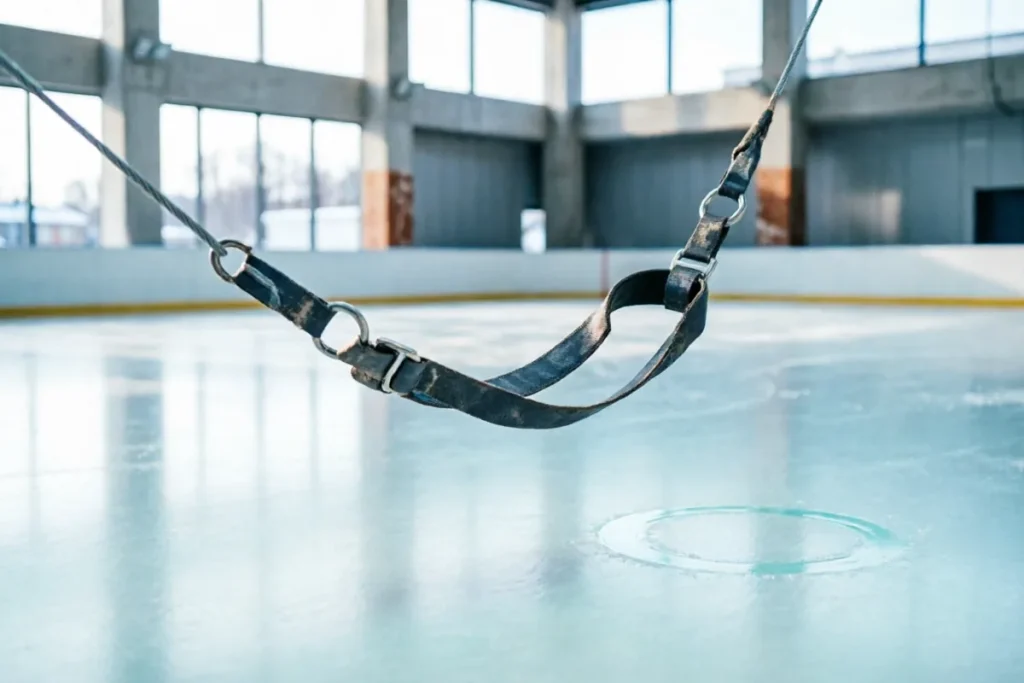
A figure skating jump harness supports a skater through a cable and pulley or tracking system, helping control a jump while still allowing movement across the ice. The coach can use it to introduce difficult multi-rotational jumps, including the Axel, Lutz and Salchow.
During a supported attempt, the skater can focus on the jump’s sequence and body position rather than treating every try as a test of an unaided landing. The harness provides assistance in the air, giving the skater room to practise how the jump develops from take-off through rotation.
What the harness does not replace
A harness can reduce the consequences of a fall during practice, but it does not make an attempt risk-free. It also cannot replace coaching: a coach still needs to guide the jump and judge the skater’s position and movement.
The equipment must be set up appropriately for the skater and the training session. Support depends on the harness connection and tracking system working as intended, so sound setup remains part of the practice—not an optional extra.
What can a harness teach during jump practice?
A jump harness can help a skater rehearse a compact air position and controlled rotation while receiving support, then let a coach focus each attempt on a specific part of the jump.
Use one technical cue at a time
For a skater who struggles to find an air position, support can make it easier to practise drawing the body into a compact shape and controlling rotation. The harness provides support; it does not identify what the skater should change.
A coach can use repeated supported attempts to direct attention to one technical cue, such as posture, take-off position or the movement into the landing. Keeping the task clear helps the skater focus on that part of the jump rather than treating support as a correction in itself.
- Posture: Notice the skater’s body position during the jump.
- Take-off: Focus on the position from which the jump begins.
- Landing: Observe how the movement carries into the landing.
Check confidence without support
A harness may make a new jump feel less frightening by reducing the fear of falling during practice. But confidence on the harness is not the same as confidence on the ice without it.
Return to unaided practice to see whether the skater can keep the intended body shape and movement without support. If the jump changes, the coach can identify which cue needs more work.
How does a jump harness differ from video feedback?
A jump harness changes the physical conditions of practice by supporting the skater; video feedback lets a coach and skater review movement without that support. The tools answer different questions: the harness helps rehearse a movement, while video makes visible differences between attempts easier to inspect.
- Jump harness: Physical support can help a skater practise a jump movement, but it does not show whether the movement is consistent without support.
- Dartfish video: Coaches started using Dartfish about 20 years ago to play back and overlay videos of students’ jumps in real time. Comparing attempts can help identify visible differences, but playback alone does not establish consistency.
Neither tool is a verdict on the jump. A harness can assist rehearsal; video can help the coach and skater examine what happened. To assess consistency, they need to consider repeated attempts without treating either support or replay as proof by itself.
Training tools and competition rules
The International Skating Union raised the minimum age to compete to 17 after a young skater was caught up in a doping scandal at the 2022 Olympics. That competition rule concerns eligibility, not whether a harness is used during training.
When can harness practice fail to transfer to an independent jump?
Harness practice can fail to transfer when cable support lets a skater complete a rotation without showing the timing and control needed to do it independently on the ice.
Support is not a consistency test
A jump harness changes the conditions of the movement: the cable supports the skater while they rotate. Completing a jump with that assistance shows that the movement can be performed under support; it does not prove the skater can create the same take-off, rotation timing or landing without it.
A skater may finish the movement in the harness and still need to refine a specific part on the ice. The take-off may not produce the needed rotation, the air position may arrive at the wrong time, or the landing may be difficult to control.
Repeated supported attempts can also reinforce an unhelpful movement. If a coach does not notice it and correct the cue, the skater may keep practising the same fault rather than improving the jump.
- Take-off: Can the skater produce it without cable support?
- Air position: Can the skater reach and hold it independently?
- Landing: Can the skater control the landing on the ice?
Progressive unaided practice is the practical test: check whether the skater can repeat the take-off, air position and landing without relying on the harness. If one part breaks down, return to that part of the movement and refine it before treating the jump as independent.
Which practice method fits the skater’s immediate need?
Choose a jump harness when the skater needs physical assistance to rehearse a difficult jump movement; choose video review to inspect visible positions without changing the skater’s support.
- Jump harness: Use it when the practice task is to work through a challenging movement with support and reduced fall risk. The skater can focus on the jump while the harness provides physical assistance.
- Video review: Use it when the coach and skater need to compare positions or review a jump as performed. Video lets them examine the movement without adding physical support.
- Both methods: A coach can support a rehearsal with a harness, then review the movement on video. Keep unaided attempts separate: they show how the skater performs without harness assistance.
These methods answer different questions. Harness practice changes the conditions of the movement; video review records it. A video of a supported rehearsal should not be treated as evidence of an unaided attempt.
For harness setup, attachment and supervision, follow the instructions for that specific system and the coach’s direction.
Frequently asked questions
Does a jump harness guarantee a safe landing?
Can a harness help with any jump?
Does completing a jump in a harness prove the skater can do it alone?
Should a skater use a harness or video review?
Key takeaways
- A jump harness supports a skater physically during practice; it does not certify an unaided jump.
- Use harness time for a defined task such as air position or posture, with a coach identifying the cue.
- Dartfish video playback and overlays offer a review tool that does not provide physical support.
- Judge transfer through unaided attempts, especially the take-off, timing and landing.
Sources
- jumpharness.com — “Figure Skating Jump Harnesses – Jump Harness, Figure Skating”
- experientialsystems.com — “Experiential Systems, Inc. – Jump Harness, Figure Skating”
- patents.google.com — “US4410175A – Safety suspension unit and harness for developing jumps in figure skating – Google Patents”
- pro-motionharness.com — “Home – PRO-MOTION Harness Systems”
- goldenskate.com — “Using Jump Harness for Low Level Jumps?”