How to Choose Hockey Shin Guards for Fit and Mobility
Choose hockey shin guards that cover your knee and shin without restricting your stride or bending your knee. Check the fit in your skating stance, with your skates and hockey pants on.
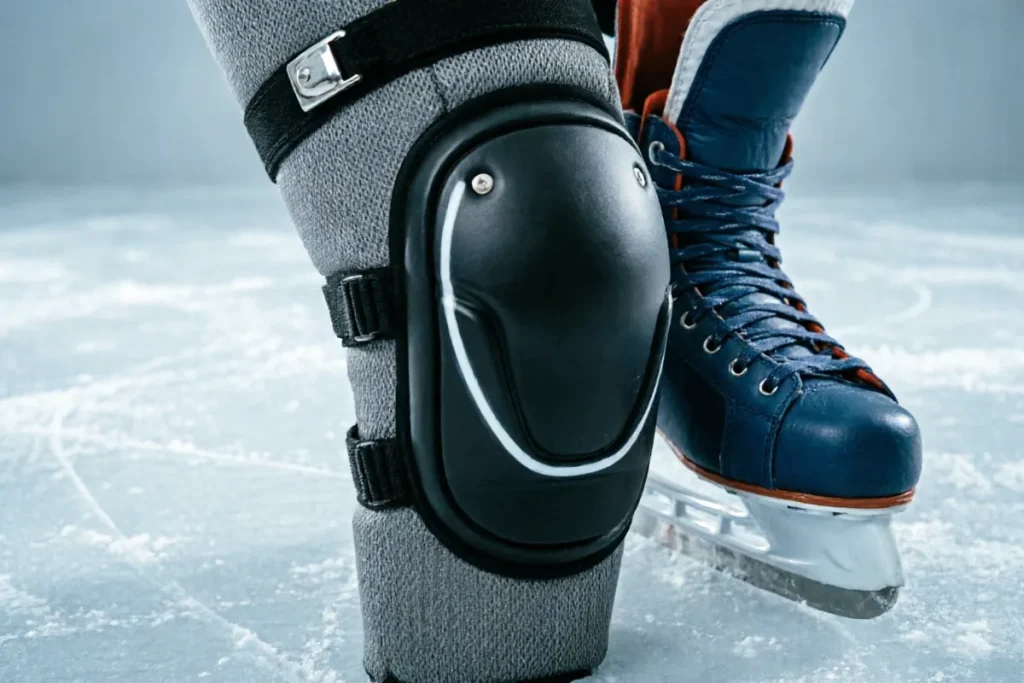
The right size depends on how the guard sits between your skate tongue and knee, not just the label. A guard that shifts, leaves a gap, or presses into your knee can compromise coverage or make skating uncomfortable.
When choosing hockey shin guards for fit and mobility, check how securely they stay in place and whether you can move freely through a skating stride. Try them with your full gear before deciding.
| Decision | What to check | Fit signal |
|---|---|---|
| Size | Kneecap centre to skate-boot top | Guard length matches the measurement |
| Knee coverage | Plastic cup with knee slightly bent | Kneecap remains centred |
| Lower coverage | Guard edge and ankle bone | Edge sits just above the ankle bone |
| Straps and tape | Leg bent and straightened | Guard stays aligned without pinching |
How do you size a hockey shin guard?
Size a hockey shin guard by measuring from the centre of your kneecap to the top of your skate boot in centimetres, then choosing a guard with a listed length that matches.
- Measure: Place one end of the measurement at the centre of the kneecap and follow the front of the leg down to the top of the skate boot.
- Match the length: Compare your measurement with the shin guard’s listed length in centimetres. Check the product’s sizing information rather than relying on a size label alone.
- Check the kneecap: Put the guard on and bend your knee slightly. Your kneecap should sit centred in the plastic cup, not above or to either side of it.
- Check the ankle and boot: The lower edge should reach just above the ankle bone without catching on or blocking the skate boot.
Use the bent-knee fit to confirm your measurement: a guard can match the listed length and still sit incorrectly if its cup does not centre over your kneecap. Recheck the position while wearing your skates, since the lower edge needs to clear the boot.
How do anatomical and traditional designs differ?
Anatomical shin guards curve closer to the leg, while traditional guards have a roomier shape; the better fit is the one that stays in place without pressing into your knee or calf when you bend.
- Anatomical design: The closer-fitting shell can feel secure, but check for pressure at the kneecap and calf with your knee flexed. A shell that digs in while you bend may restrict movement.
- Traditional design: The more spacious shape may feel less restrictive on a wider leg. It should still sit steadily: if the guard rotates or slides as you move, it is not a secure fit.
Compare how much shell covers your kneecap and shin, not just how narrow or wide the guard looks from the outside. The kneecap should sit centered in the plastic cup with your knee slightly bent; check that the shell also covers the shin without leaving an uncomfortable gap near the skate.
Test both shapes in skating posture
Try each style with your knee flexed and your skate laced. The laced skate matters because the lower edge of the guard sits beside the boot, and the fit can feel different once your ankle is held in skating position. Bend and shift your weight: the guard should remain aligned over the kneecap and shin without pinching or slipping.
Where should the straps sit for a secure fit?
Hockey shin guard straps should hold the guard in place without pinching behind your knee or squeezing your calf. Fasten them firmly enough to keep the pad aligned, but loosen or reposition a strap if it causes pressure.
Check the fit with your leg slightly bent, then bend and straighten it. Your kneecap should stay centred in the guard’s cup as the knee moves; if it shifts, adjust the guard before tightening the straps again.
Check the full setup
A hockey sock and skate can change where the straps sit and how freely your leg moves. Try the shin guards with both on, then flex your knee and ankle. Check that the straps remain comfortable and the guard stays aligned.
Sock tape can limit movement during play. Wrap it around the guard and sock snugly, not tightly: the tape should secure the pad without adding calf compression or restricting movement.
When do full-face protection rules differ?
Full-face protection rules differ by governing body and player category: USA Hockey exempts adults, while Hockey Canada’s rule applies only to players registered in minor and female hockey.
- USA Hockey Rule 304(g): Adults are exempt from the full-face-protection requirement.
- Hockey Canada Rule 3.6(c): The rule applies only to players registered in minor and female hockey.
Helmet certification is a separate USA Hockey requirement. Rule 304(c), (e) requires a HECC-certified helmet in every age classification except Adults. Adults must wear a hockey helmet, but it may be non-HECC-certified; the chin strap must be fastened.
These distinctions matter when comparing equipment choices: an adult exemption from full-face protection does not remove the requirement to wear a helmet under USA Hockey’s adult rule. Check the rules that govern your league before treating equipment choices as interchangeable.
What this means for shin-guard fit
These helmet rules do not determine shin-guard fit. Choose shin guards by checking that the kneecap sits in the center of the guard’s cup with the knee slightly bent, and that the guard reaches the top of the skate boot. Follow your league’s equipment rules separately.
What fit problems should you check before buying?
Check shin-guard length, kneecap position, and strap pressure while your knee is bent; a guard that fits standing still can shift or restrict your skating stance.
- Guard length: The lower edge should reach the top of the skate boot without interfering with it. If the guard ends too high, it leaves the lower shin exposed.
- Kneecap alignment: Bend your knee slightly and check that the kneecap sits in the centre of the plastic cup. If the cup moves off-centre in this position, the fit is wrong even if the guard feels comfortable while you stand upright.
- Strap pressure: Use the straps or sock tape to keep the guard aligned, but do not pull them so tight that the shell presses painfully into your leg. A secure fit should still let your knee bend freely.
- Shell shape and movement: Walk through a skating stance and bend your knees. If the shell shifts, pinches, or limits your movement, try another size or shape rather than tightening it further.
For a final check, wear the guard with your skate and hockey sock: confirm that the boot and guard do not clash, the lower shin stays covered, and the kneecap remains centred when you bend your knee.
Frequently asked questions
How do I measure for hockey shin guards?
Where should my kneecap sit?
Should the shin guard go over or under the skate tongue?
Can I use tape to stop shin guards moving?
Sources
- Better Hockey US — “Shin Guard & Pants Fit Guide | Better Hockey”
- newtohockey.com — “Shin Guard / Shin Pad Guide for Hockey Players – New To Hockey”
- hockeymonkey.com — “Hockey Shin Guard Sizing Chart & Guide: How to Measure Shin Guards”
- ONE Sports Warehouse — “How To Choose Field Hockey Shinpads”
- dickssportinggoods.com — “Soccer Shin Guard Buying Guide”