Wintersport Ice: Why Rough Ice Still Feels Slippery
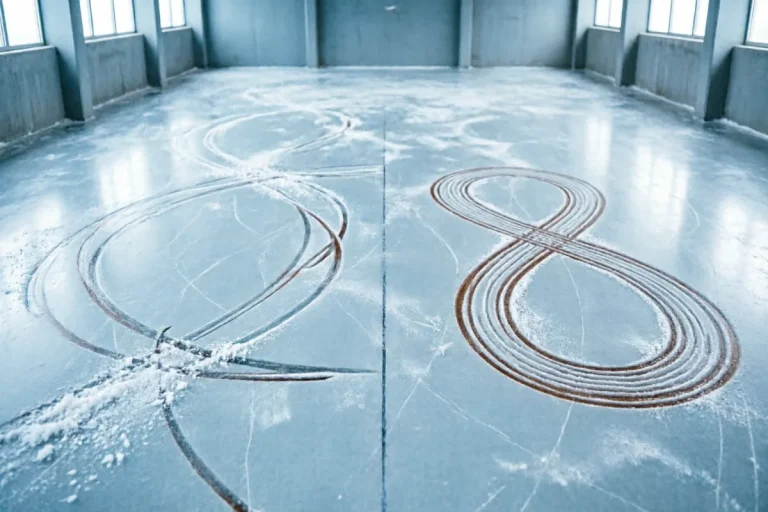
Rough ice still feels slippery because pressure and friction can create a thin layer of water beneath a skate blade. The surface may feel uneven, but that microscopic layer helps the blade glide rather than grip.
The numbers
Radius of a modern figure-skating blade’s slight curve
Thickness of an ice-hockey puck
Diameter of an ice-hockey puck
Texture changes how a skate moves: grooves and bumps can make the ride feel rough or unpredictable, even when the blade is sliding. Understanding why rough ice still feels slippery helps explain the balance between glide and control on the rink.
| Equipment | Contact form | Relevant detail |
|---|---|---|
| Figure-skating blade | Curved blade meets ice along a narrow contact area | NIST gives curve radius as 180 cm to 220 cm |
| Ice-hockey puck | Compact object slides across the ice | NIST specifies 2.54 cm thickness and 7.62 cm diameter |
| Both | Contact with the ice can be affected by surface lubrication | Visible roughness alone does not establish grip |
- 156 g to 170 g Required weight range for an ice-hockey puck
Why can wintersport ice feel slippery when it looks rough?
Wintersport ice can feel slippery despite looking rough because a liquidlike layer can form on its surface below freezing, helping a skate slide. This process is called premelting: the ice remains solid underneath while its boundary has some liquidlike character.
Premelting helps explain why visible texture alone cannot tell you how much grip a skate will get. The surface molecules sit at the boundary between solid ice and the liquidlike layer, where they are less orderly than molecules deeper in the solid; that different arrangement contributes to the surface’s unusual behaviour.
Surface state matters as much as appearance
A rough-looking patch is not necessarily grippier than a smooth-looking one: what matters is not only the shape of the ice but also the state of its surface. Pressure and friction from a moving skate can also contribute to melting at the contact area, adding water that reduces friction. The interaction is complex, so roughness alone is not a reliable guide to how the ice will feel under a blade.
How do temperature and pressure change the surface?
Temperature and pressure change an ice surface by affecting whether a thin, liquidlike layer forms at its boundary. Premelting can occur well below freezing, so cold air does not guarantee that the ice is completely dry. Disordered water molecules at the boundary help explain how this surface layer can act as a lubricant.
Pressure from a person or skate can also contribute to melting where the ice is pressed. The resulting thin film of water can reduce friction at the contact area, though this is not the only way ice becomes slippery. Pressure-related melting and the behaviour of water molecules at the ice boundary are distinct influences that can operate together.
Why glide has no single cause
Ice’s response depends on the interplay of temperature, pressure and the condition of its surface. Premelting helps explain slipperiness in cold conditions, while pressure can add to the liquid layer beneath a skate or foot. Neither effect alone accounts for every instance of glide.
How does a skate blade meet the ice?
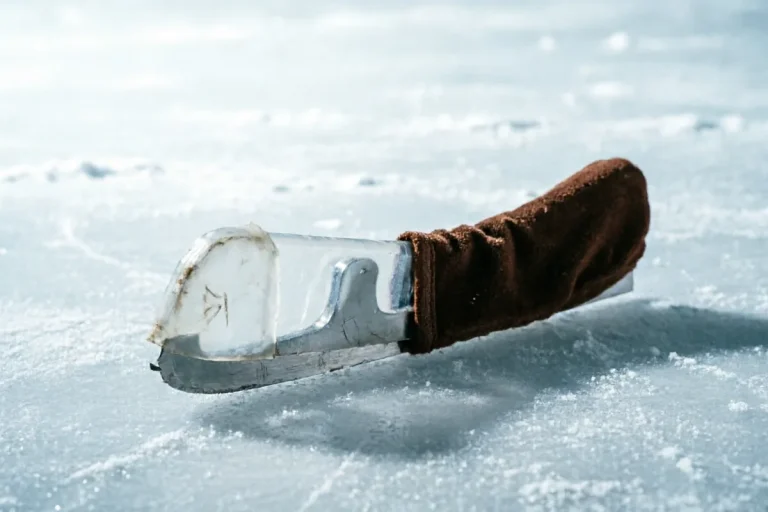
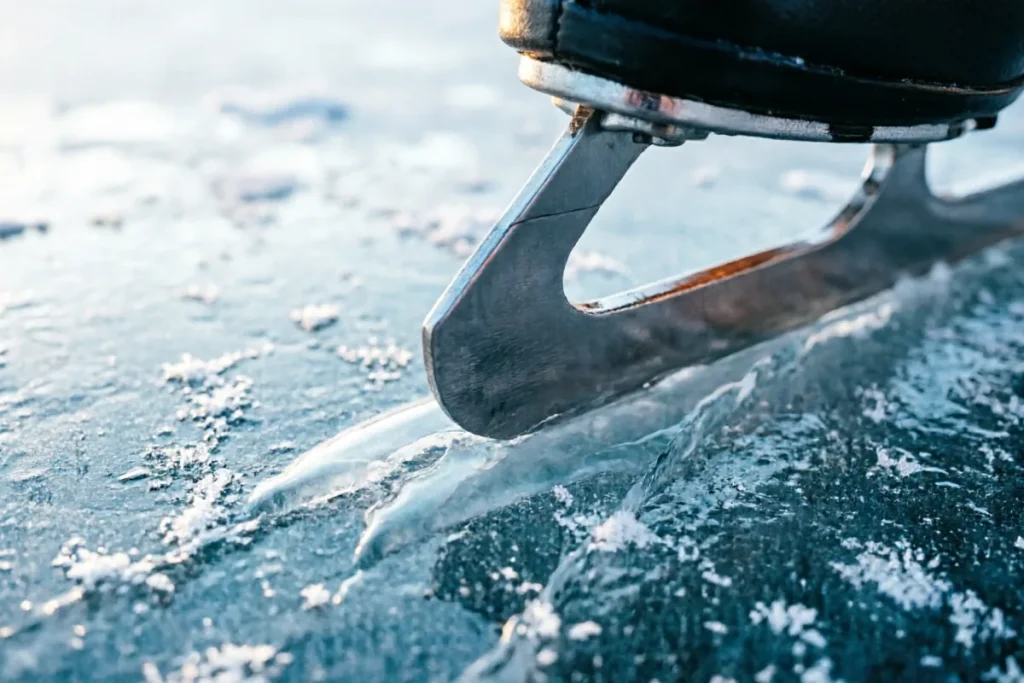
A skate blade meets the ice along a narrow contact region, where the skater’s weight is concentrated; that interface, rather than the entire rink, is where grip and glide matter. The blade is not a flat strip resting across the surface: its slight curve shapes how it touches the ice as it moves.
NIST gives the radius of a modern figure-skating blade’s slight curve as 180 cm to 220 cm. As the blade travels, this curved profile affects its contact with the ice and helps determine how the skater can control movement.
Why the contact matters
A liquidlike layer on the ice may ease the blade’s motion, even when the surface looks rough. But lubrication is only part of the interaction: the blade’s contact geometry also helps shape the balance between glide and control.
What does hockey equipment reveal about ice contact?
A hockey puck and a skate blade reveal how the same ice can feel different under distinct forms of contact: the puck slides as a compact object, while the blade travels along its edge. NIST specifies that an ice-hockey puck is 2.54 cm thick and 7.62 cm in diameter, with a required weight between 156 g and 170 g. Its defined size and weight make it a useful contrast to the long, narrow edge of a skate blade.
- Hockey puck: Its broad, flat face meets the ice as the puck slides across the surface.
- Skate blade: Its edge tracks along the ice as the skater moves and turns.
Premelting can leave a liquidlike layer on ice even well below freezing, and pressure or friction can also contribute to surface lubrication. That shared lubrication helps explain why both puck and blade can slide, but it does not make their handling identical: the puck moves as a separate object, while the blade’s edge guides the skater’s path.
When does the slippery-ice explanation have limits?
Premelting helps explain ice’s slipperiness, but it does not guarantee that every patch has the same liquidlike coating. The surface layer can vary with conditions, and at low temperatures ice may still feel slippery even when a premelted layer is absent. Molecules at the surface have fewer neighboring molecules than those deeper in the solid, so the surface can behave differently from the ice beneath it.
Why appearance cannot tell you the grip
Pressure from a skate blade may contribute to melting at the contact point, but pressure-induced melting is only one proposed part of the explanation; the molecular properties of the ice surface matter too. A rough patch, a temperature change or altered contact between blade and ice can change how a skate feels on the surface. That is why visible roughness alone is an unreliable guide to grip: two areas that look similar may feel different under a blade, and a rough-looking patch is not proof that its surface behaves the same way as smoother ice.
What should a skater notice on the ice?
A skater should compare what the ice looks like with how the blade actually glides and responds; a rough-looking surface does not necessarily provide more grip. Watch for changes in glide as you move across the rink, and notice whether the blade feels different as temperature and pressure vary.
Read the blade’s response
Ice can have a thin, liquidlike surface layer even below freezing, a phenomenon called premelting; pressure and friction can also affect the contact between blade and ice. That means “wet” or “dry” is not a reliable verdict on traction by appearance alone. Use controlled blade edges and a balanced stance to manage contact, adjusting to the way the skate behaves rather than relying on the surface’s look.
For rink conditions, judge the ice beneath your equipment: its appearance may not match how it interacts with the blade. Pay attention to whether your skates glide, hold an edge or feel less predictable, and let that feedback guide your control.
Frequently asked questions
Why is ice slippery even below freezing?
A liquidlike layer can form on ice below freezing through premelting. Pressure at a skate’s contact point may also contribute to a thin water layer.
Does rough ice always provide more grip?
No. Rough-looking ice can still have a lubricating surface layer, so appearance alone does not determine how a blade will grip.
Does pressure from a skate melt ice?
Pressure from a person or skate can contribute to melting at the contact area. It is one part of a more complex explanation of ice friction.
How curved is a modern figure-skating blade?
NIST gives the radius of its slight curve as 180 cm to 220 cm. The curve shapes how the blade meets the ice.
Key takeaways
- Premelting can create a lubricating surface layer below freezing.
- Pressure at a skate’s contact area can contribute to a thin water layer.
- NIST gives a modern figure-skating blade’s curve radius as 180 cm to 220 cm.
- Rough appearance alone is not a dependable measure of grip.
Sources
- sciencenews.org — “Here’s how ice may get so slippery”
- Quanta Magazine — “Why Is Ice Slippery? A New Hypothesis Slides Into the Chat”
- aip.org — “Why Is Ice Slippery? It's Not a Simple Question – AIP.ORG”
- physics.stackexchange.com — “Being in a solid state, why is ice slippery?”
- COMSOL Blog — “Why Is Ice Slippery Enough for Skiing and Skating?”