How Thick Should Rink Ice Be?
Rink ice is typically about 1 to 1¼ inches thick (2.5 to 3 cm). The right thickness depends on how the rink is used and how its ice is maintained.
Ice that is too thin may not hold up to skating, while extra-thick ice can take longer to freeze and may be harder to keep in good condition. How thick rink ice should be also varies between recreational skating, figure skating and hockey, so thickness is only one part of creating a safe, skateable surface.
| Setting or use | Thickness or dimension | What the figure applies to |
|---|---|---|
| Hockey rink | 3/4 of an inch | Commonly cited ice thickness |
| Most hockey rinks | 1 to 1.25 inches (2.54 to 3.18 centimeters) | Another stated thickness range |
| Backyard rink | at least three inches | Outdoor skating guidance, not indoor rink thickness |
| German League rink | 56 to 61 yards long; 26 to 30 yards wide | Rink dimensions, not ice depth |
- 1 to 1.25 inches (2.54 to 3.18 centimeters) Stated range for standard ice thickness in most hockey rinks
How thick is ice in a hockey rink?
Hockey-rink ice is commonly described as 3/4 of an inch (19.05 millimeters) thick, while another stated range for most rinks is 1 to 1.25 inches (2.54 to 3.18 centimeters). These figures refer to maintained rink surfaces, not outdoor pond ice or a backyard sheet.
Why published figures differ
Published rink figures use different thickness descriptions: one gives a single commonly cited depth, while the other gives a range for most hockey rinks. They should not be treated as one universal specification.
- 3/4 inch (19.05 millimeters): A commonly cited rink-ice thickness.
- 1 to 1.25 inches (2.54 to 3.18 centimeters): A stated range for ice in most hockey rinks.
- Outdoor pond or backyard ice: A different context; rink thickness figures should not be applied to these surfaces.
Rink operators need to measure the actual ice surface rather than assume a depth based on a general figure. The measured thickness—not a number quoted for another rink or type of ice—is the useful basis for assessing the surface.
How do temperature and refrigeration affect the ice?
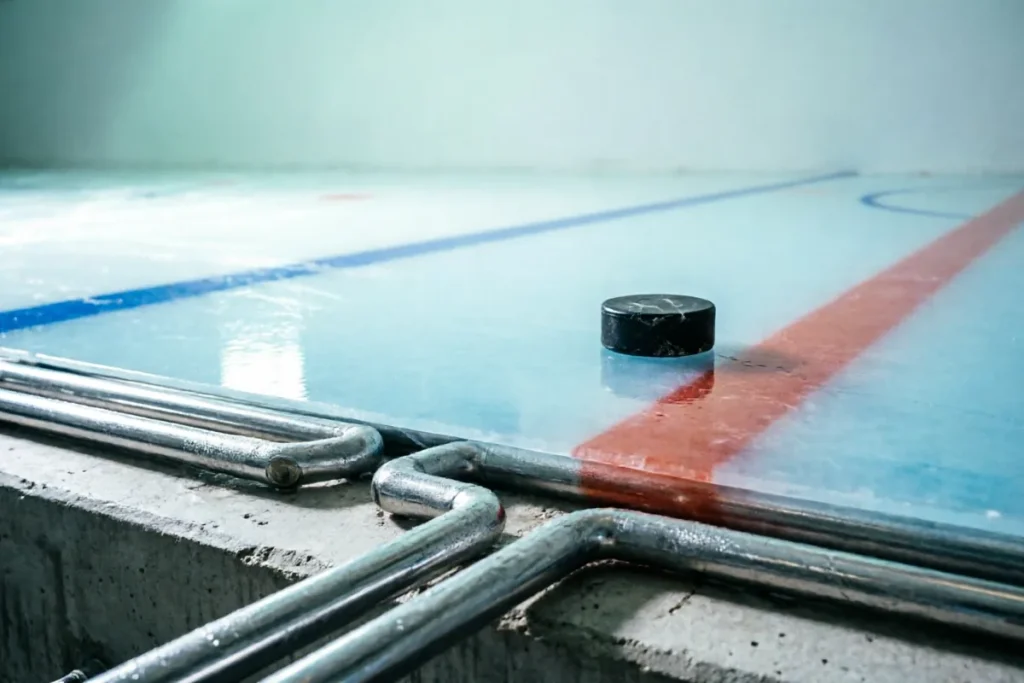
A rink refrigeration system keeps the ice frozen by drawing heat through the floor, while arena air and activity add heat to the sheet. Temperature control therefore affects how the surface feels and performs, not just whether it remains frozen.
Ice depth and ice temperature are related but not interchangeable: adding thickness alone does not guarantee a firm, fast surface. When an operator floods the rink, the added water must freeze before the surface is ready; the cooling system has to remove that water’s heat. If the sheet is used before it has adequately refrozen, its response to skating and other activity may differ from that of a well-prepared surface.
What temperature control changes
Temperature and surface preparation influence glide, edge grip and how quickly the ice responds to use. A rink operator balances cooling with flooding and resurfacing, because each fresh layer adds water that must freeze. Ice thickness describes how much ice is present; temperature and preparation help determine the skating conditions on top.
Why do rink operators adjust ice for different activities?
Rink operators adjust ice conditions because hockey, figure skating and curling require different surface behaviour, not one universal setting. Hockey needs a surface that lets the puck travel predictably while giving players’ skate edges enough grip to turn, stop and accelerate; too much emphasis on either speed or traction can compromise the other.
Figure skating places different demands on the ice: skaters need reliable edges for turns and enough support for take-offs and landings. Curling, by contrast, relies on a deliberately prepared playing surface for stones to travel and curl, rather than on the smooth, fast puck travel sought in hockey.
Match the surface to the schedule
Arena managers can tailor ice preparation to the activity on the schedule instead of treating ice quality as a fixed setting. The practical criteria differ by use:
- Hockey: balance predictable puck movement with secure skate edges.
- Figure skating: support turns, jumps and landings.
- Curling: prepare the surface for stone travel and curl, not hockey-style puck movement.
How does rink size change the ice-management problem?
Rink size changes how much ice the refrigeration system must maintain and how much surface resurfacing must cover; it does not determine how thick the ice should be. The German League requires rink dimensions of 56 to 61 yards long and 26 to 30 yards wide.
The German League’s permitted dimensions create different surface areas for cooling and resurfacing to serve. A wider sheet means more area to manage, not a requirement for deeper ice: rink dimensions and ice-thickness specifications are separate decisions.
Keep dimensions separate from thickness
- League dimensions: Use the German League’s length and width requirements to assess the playing surface.
- Rink thickness specification: Check the particular rink’s required ice depth separately; do not infer it from the sheet’s width.
- Ice management: Match refrigeration and resurfacing to the rink’s actual footprint.
Why do local conditions matter to ice management?
Local conditions matter because each arena’s climate and operating environment change the heat load its refrigeration system must manage. A rink in a maritime climate faces a different setting from one in a desert region, so a single ice-management setting cannot be assumed to work equally well in every building.
The study included responses from 14 U.S. states and 8 Canadian provinces, spanning the Pacific Northwest, including Washington and British Columbia, the Prairies, desert regions, temperate zones, and maritime climates. That breadth makes local climate relevant to interpreting ice-management practices, rather than treating them as universal instructions.
Use arena-specific operating conditions
The study combined expert survey responses from 55 North American ice arena managers with existing literature to identify ice-management practices. For a particular rink, managers should use its own operating conditions to guide refrigeration and ice decisions; assuming one setting suits every building overlooks differences in local heat and climate.
When is the usual rink-thickness figure misleading?
A usual thickness figure is misleading when it is treated as a universal safety threshold: indoor arena ice and backyard ice are different settings, and a rule for one should not be transferred to the other. The backyard advice about needing at least three inches is not a test for an indoor arena sheet.
Avoid mixing indoor and outdoor guidance
Indoor hockey-rink figures describe arena ice, while backyard guidance concerns an outdoor rink exposed to changing conditions. An indoor thickness figure cannot establish whether outdoor ice is safe; assess outdoor ice on its own, rather than borrowing an arena measurement.
Thickness is only one check
Ice thickness alone does not tell a skater whether the surface is suitably cold, smooth or well maintained. A typical figure describes common practice, not a guarantee that a particular sheet is ready for skating.
- Indoor arena: Follow the rink operator’s checks and instructions; a typical thickness is not a substitute for them.
- Backyard rink: Treat backyard guidance as specific to that outdoor setting, not as a standard for arena ice.
- Outdoor ice: Do not infer safety from the stated thickness of an indoor rink.
Frequently asked questions
How thick is ice in a hockey rink?
Does thicker rink ice mean better skating?
Is three inches the right thickness for an indoor rink?
Why does ice need refrigeration if it is already frozen?
Key takeaways
- A commonly cited hockey-rink sheet is 3/4 of an inch thick; another stated range is 1 to 1.25 inches.
- Ice thickness, surface temperature, and refrigeration work together but are not interchangeable measures.
- Hockey, figure skating, and curling place different demands on the ice.
- Do not confuse indoor rink measurements with backyard-ice guidance of at least three inches.
Sources
- flohockey.tv — “How Thick Is The Ice In A Hockey Rink?”
- WBS Penguins — “Importance of Ice Thickness in Ice Hockey”
- snipersedgehockey.com — “Backyard Rink: Tricks, Tips and Lessons Learned”
- omha.net — “The Do's and Don'ts of Backyard Rink Building”
- pmc.ncbi.nlm.nih.gov — “Arena ice quality and perspectives on optimizing performance and addressing emerging challenges”