Wintersport Ice: How Rink Refrigeration Works
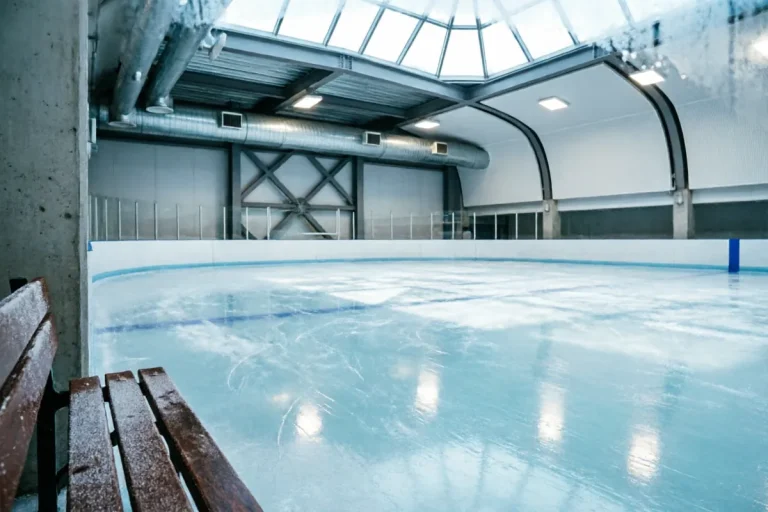
Rink refrigeration keeps the ice frozen by circulating chilled fluid through pipes beneath the rink surface. The system removes heat from the ice and carries it away, allowing the surface to stay cold enough for skating.
The numbers
Radius of the very slight curve of a modern figure skating blade
Curling rink dimensions
Hockey puck dimensions
That hidden cooling loop is what makes a reliable sheet of ice possible, even when the air around it is warmer. Understanding how rink refrigeration works helps explain why ice quality depends on more than the surface you see: the cooling equipment, rink floor and surrounding conditions all play a part.
| Component | Location | Role |
|---|---|---|
| Chiller | Refrigeration plant | Cools the circulating brine or glycol |
| Cooling pipes | Embedded in the concrete slab | Carry chilled fluid across the rink floor |
| Insulation | Below the slab | Limits heat transfer from the ground |
| Heated concrete layer | Below the insulation | Helps prevent the ground from freezing |
| Groundwater drain | At the base beneath sand or gravel | Provides drainage beneath the rink |
- 156 g and 170 g Lower and upper limits of the hockey puck's required weight
How does rink refrigeration keep wintersport ice frozen?
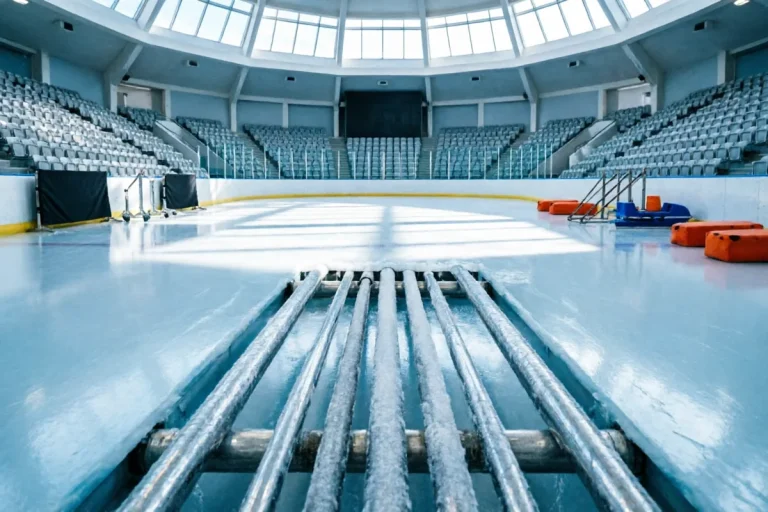
An indirect rink refrigeration system keeps wintersport ice frozen by pumping chilled brine or glycol through pipes embedded in the concrete floor beneath the ice. The refrigeration plant cools the circulating liquid; the pipes do not simply carry cold air under the rink.
The pipe network runs across the floor, allowing the moving fluid to draw heat from the ice through the concrete slab. As the fluid absorbs that heat, it returns to the chiller, where it is cooled again before being sent back through the pipes.
The continuous heat-removal loop
Rink refrigeration works as a repeating cycle: the chiller removes heat from the brine or glycol, the cooled fluid carries that cooling capacity beneath the ice, and the returning fluid brings absorbed heat back to the plant. This ongoing circulation helps keep the ice frozen across the rink surface.
What layers sit beneath the skating surface?
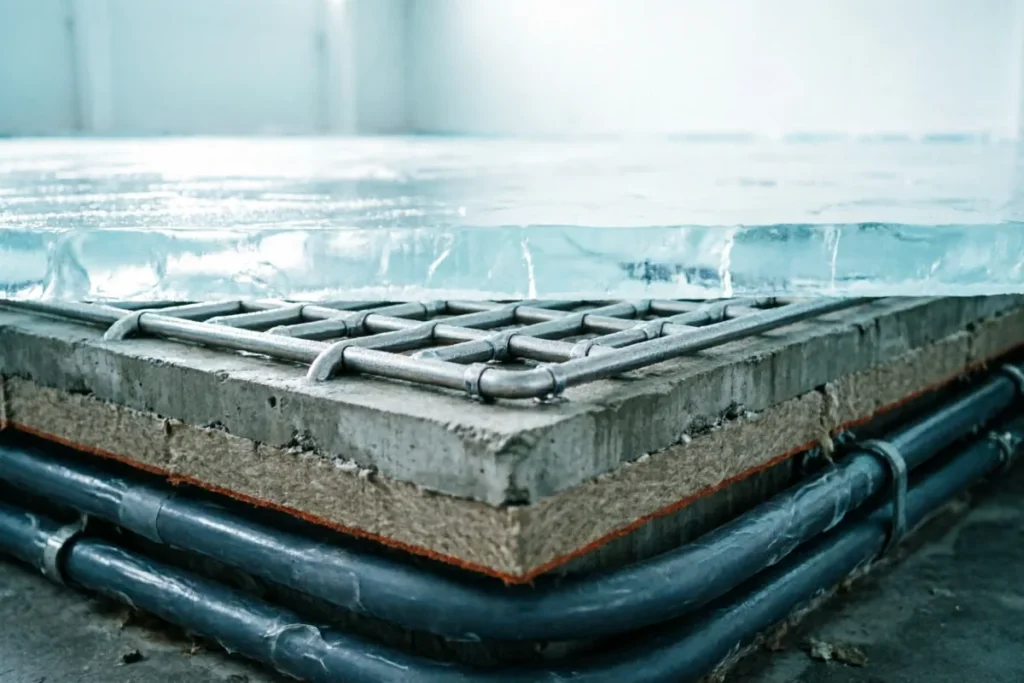
The layers beneath a skating surface typically include a concrete slab with cooling pipes, insulation, heated concrete, and a base of sand or gravel with a groundwater drain. Together, they carry the ice and rink structure while managing heat moving between the frozen surface and the ground.
The concrete slab directly below the ice contains the cooling-pipe network, which circulates chilled fluid to keep the slab cold enough to freeze the water above it. Beneath the slab, insulation limits heat transfer from the ground, helping the refrigeration system keep the ice frozen.
Protecting the ground and rink base
A heated concrete layer below the insulation helps prevent the ground beneath the rink from freezing; frozen ground can damage the rink structure. Under that layer, the rink base may use sand or gravel, with a groundwater drain at the bottom to carry water away from the foundation.
How does rink ice interact with figure-skating blades?
Rink ice transfers heat toward the cooled concrete slab, while circulating brine or glycol carries that heat through embedded pipes back to the refrigeration system. The skating surface is not a separate frozen sheet independent of the floor: the slab and its pipe network help maintain the ice above them.
How the blade meets the ice
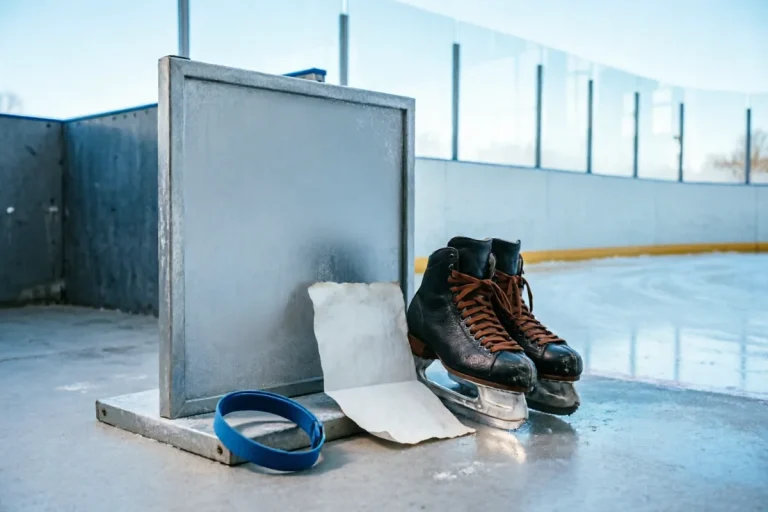
A modern figure-skating blade has a very slight curve, equal to the radius of 180 cm to 220 cm. For a skater, that curve is a reminder that ice conditions affect how the blade meets the surface; refrigeration helps maintain the ice, but does not alone determine glide or edge feel.
How do rink layouts differ by sport?
Rink layouts differ by sport because curling and hockey use different playing-area dimensions and equipment, even though both rely on a prepared ice surface. The curling rink is 42.07 m long and 4.28 m wide. Hockey’s puck is 2.54 cm thick and 7.62 cm in diameter and must weigh between 156 g and 170 g.
Layout and refrigeration serve different purposes
Curling’s specified rink dimensions define its playing area, while the hockey puck’s dimensions and weight define the equipment used on the ice. These sport-specific requirements are separate from the refrigeration loop: chilled fluid circulates through pipes beneath the rink surface to remove heat and keep the ice frozen.
A rink’s cooling system supports the playing surface; it does not make curling and hockey layouts interchangeable. Each sport still requires its own suitable area and equipment, regardless of how the ice is refrigerated.
Why can the surface feel different while the rink is still frozen?
A rink can remain frozen while its grip, glide, and texture change because refrigeration removes heat through the slab, but does not control every condition at the ice surface. The chilled fluid circulating in pipes beneath the ice keeps the slab cold; it does not prevent fresh water used in maintenance or skate blades wearing the surface from changing what skaters encounter.
What changes the skating surface
Fresh water added during ice maintenance freezes into the existing surface, while skating gradually marks and wears it. Those processes can leave parts of a rink feeling different even though the ice is still frozen; local use and preparation matter as well as refrigeration.
Visitors can look for maintenance activity and ask rink staff whether the surface has recently been resurfaced. That gives useful context for judging the ice: a frozen rink is not necessarily uniform in feel from one area to another.
When can rink refrigeration fail to protect the ice?
Rink refrigeration can fail to protect the ice when a chiller fault or a problem with fluid circulation or the pipes embedded in the slab interrupts heat removal. The chilled brine or glycol then cannot draw heat from the ice as intended, making the surface harder to keep frozen. Soft, wet or uneven patches are reasons to alert rink staff, but they do not identify which part of the system, if any, has failed.
Cooling, ground protection and surface condition
The heated layer beneath the rink has a separate job from refrigeration: it helps stop the ground below from freezing, which could threaten the rink structure. Insulation slows heat transfer, while a sand or gravel base and groundwater drain help manage water; none of these replaces active cooling through the slab.
Visitors should report changes in the ice to rink staff rather than diagnose a mechanical fault from appearance alone. A soft or wet area may be a surface condition, while confirming a chiller, circulation or pipe-network problem requires checking the refrigeration system.
Frequently asked questions
What fluid runs beneath an ice rink?
Many rink systems circulate chilled brine or glycol through pipes embedded in the concrete slab. The fluid carries heat from the rink floor back to the chiller.
Do the pipes run through the ice?
No. They are embedded in the concrete floor beneath the skating surface, where they cool the slab and remove heat from the ice above.
Why is there a heated layer under an ice rink?
A heated concrete layer below the insulation helps keep the ground beneath the rink from freezing, which could damage the structure.
Does refrigeration alone determine how the ice feels?
No. Refrigeration removes heat through the slab, while surface preparation and skating wear also affect the ice that skaters encounter.
Key takeaways
- Chilled brine or glycol circulates through pipes embedded in the concrete slab.
- The slab carries heat from the ice to the circulating fluid and back to the chiller.
- Insulation, a heated layer, and groundwater drainage protect the rink structure below.
- Surface feel also depends on preparation and use, not refrigeration alone.
Sources
- Chart Industries — “Ice Rinks: Refrigeration On A Big Scale. What’s under the surface you skate on?”
- rockyrinks.com — “Ice Rink Refrigeration System Guide”
- WBS Penguins — “How Hockey Rink Ice is Made: The Science Behind Perfect Ice”
- iceskatingresources.org — “History of Developing Refrigerated Rinks – Ice skating Resources”
- NIST — “Metric in Sports: Winter Games Fast Facts”