Why Indoor Ice Rinks Fog Up
Indoor ice rinks fog up when warm, moisture-laden air meets the cold ice or other chilled surfaces. The air cools, can no longer hold as much water vapour, and tiny droplets form a visible mist.
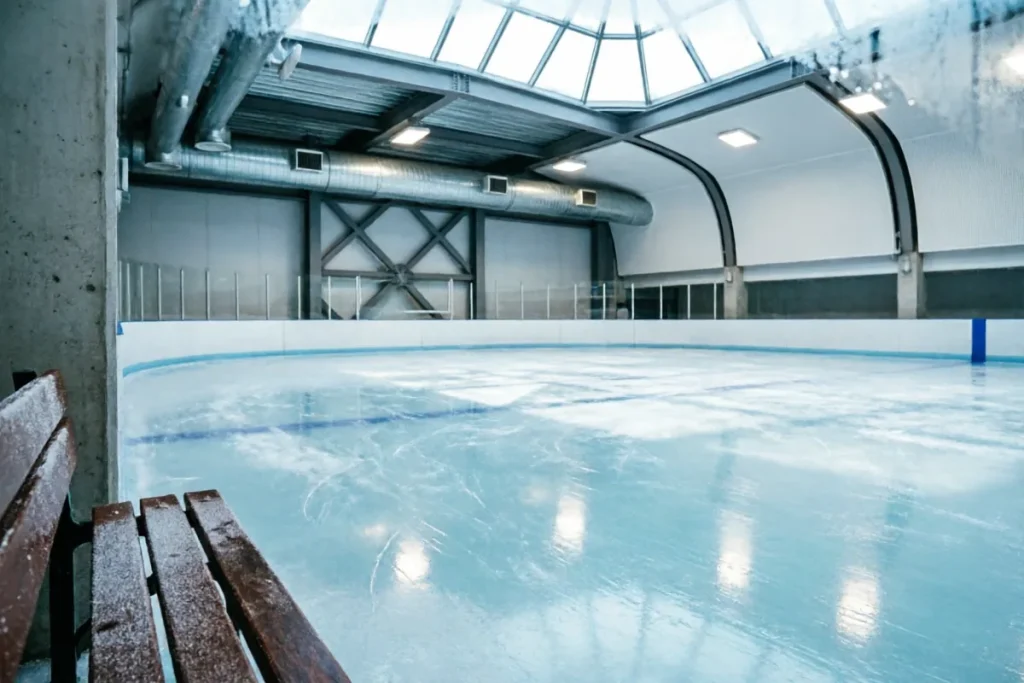
That fog can blur the rink and make it harder to see the ice clearly. Understanding how temperature, humidity and ventilation interact helps explain why haze appears—and why managing rink air matters as much as keeping the ice cold.
| Response | When it may help | Trade-off to check |
|---|---|---|
| Ventilation | Incoming air is drier than rink air | Humid outdoor air can add moisture |
| Dehumidification | Indoor air contains excess moisture | Check visibility and ice conditions after adjustment |
| Air circulation | Fog is unevenly distributed | May move haze without removing moisture |
| Cooling | Temperature needs adjustment | Can raise relative humidity if moisture remains |
What makes rink ice fog up indoors?
Dew point, not just rink temperature
Indoor rink ice fog forms when moist air near the cold ice cools to its dew point, causing liquid water droplets to hang in the air. It is not smoke, nor vapour rising from the ice: the visible haze is made of tiny droplets formed from moisture already in the air.
The dew point depends on both air temperature and relative humidity, so rink temperature alone cannot predict whether fog will appear. Two air masses at the same temperature can have different dew points if their humidity differs; the more humid air can reach condensation after less cooling.
How fog forms around the ice
A cold ice surface cools the air close to it, while warmer, wetter air can enter through doors or arrive from spectator areas and adjoining spaces. If that incoming air cools enough to pass its dew point, water condenses into droplets and creates fog above or around the rink.
- Air temperature: determines how much cooling the air experiences near the ice.
- Relative humidity: indicates how much moisture the air contains and helps determine its dew point.
- Moisture source: doors, spectators and adjoining spaces can introduce warmer, wetter air that may condense when cooled.
How do humidity and ventilation affect rink visibility?
Humidity and ventilation affect rink visibility by changing how much moisture is in the air and where that air moves: fog is more likely when moist air meets a colder surface, while well-directed airflow can disperse a local haze. Relative humidity alone is not the amount of water in the air; it describes how close air is to saturation at its current temperature.
Ventilation is not automatically dehumidification.
Ventilation removes moisture only when incoming air is drier than the rink air. If outdoor air is humid, bringing it inside may add moisture instead, so operators need to assess the air’s actual condition rather than assume that more fresh air will clear the rink.
- Air temperature: Read it alongside relative humidity; the same relative-humidity value can correspond to different amounts of water in the air at different temperatures.
- Relative humidity: Use it as a measure of how near the air is to saturation, not as a stand-alone measure of moisture content.
- Dew point: Consider it with air temperature and relative humidity to assess whether moisture may condense on colder surfaces.
Air movement can break up a local fog layer, but poorly directed airflow may carry moisture across the ice or disturb conditions at the surface. Monitoring air temperature, relative humidity and dew point together gives rink operators a clearer basis for judging ventilation and visibility than relying on any one reading.
Why does fog matter to athletes and officials?
Fog matters to athletes and officials because suspended droplets can soften the contrast between the ice, rink markings and boards, making it harder to track movement. The effect depends on where the fog forms and how dense it is: a light veil in one part of the rink may leave play clear elsewhere, while denser fog across a sightline can make visual cues harder to distinguish.
For a skater, reduced visibility can make it harder to judge the landing area; for a hockey player, it can make following the puck more difficult. These are different tasks, but both depend on seeing the relevant area of the ice clearly. The practical question is not simply whether haze is visible, but whether athletes can still see the playing surface and movement well enough to perform.
Glass and sightlines
Condensation on rink glass or other surfaces can obstruct the view of officials and spectators even when the ice itself remains visible. Assess visibility separately at the ice, along the boards and through the glass: fog affecting one sightline does not automatically mean the whole rink is equally obscured.
How can organisers balance clear air with good ice?
Treat the air and the ice as one system
Organisers can keep rink air clearer by combining dehumidification, ventilation and careful adjustment of ice conditions, then checking visibility, temperature and humidity together. These controls act on the same indoor environment but do different jobs: dehumidification removes water vapour, ventilation exchanges indoor air, and cooling changes temperature.
- Dehumidification: targets moisture in the air, rather than replacing indoor air.
- Ventilation: brings in and exhausts air, but its effect depends on how air moves through the rink.
- Cooling: changes the rink’s temperature; it should be assessed alongside humidity and visibility, not treated as a stand-alone fix.
Check the effect on spectators and ice
Air circulation needs to be checked at rink level as well as in equipment settings: airflow that clears a viewing area may create uncomfortable drafts or interfere with the intended ice conditions. After any adjustment, organisers should compare visibility with temperature and humidity. If visibility improves while the ice or comfort is compromised, the change has shifted the problem rather than resolved it.
When can ventilation make rink fog worse?
Common mistake: treating more airflow as a guaranteed fix.
Ventilation can make rink fog worse when it brings warm, humid outdoor air into a colder rink, adding water vapour that can condense in the air. Opening doors and increasing outdoor-air intake are therefore not automatic fixes: their effect depends on the conditions outside as well as the rink’s operating setup.
A ventilation change can also shift where fog gathers rather than remove its moisture. One viewing angle may become clearer while another stays obscured, so judging the result from a single spot can be misleading.
- Opening doors or increasing outdoor-air intake: may add moisture when outdoor air is warm and humid.
- Changing airflow: may move fog between viewing areas without removing the moisture.
- Lowering air temperature: can raise relative humidity if the amount of water vapour remains unchanged.
There is no universal temperature or humidity threshold for when these effects occur. The outcome depends on indoor and outdoor conditions and how the rink is operated; assess the air conditions alongside visibility from more than one viewing angle.
What should organisers check before competition continues?
Organisers should continue competition only after checking sightlines, comparing rink air conditions before and after environmental changes, inspecting for condensation, and reassessing the ice. Athletes, officials and spectators should be able to see the relevant parts of the rink; check rink-side glass as well as the view across the ice.
- Sightlines: Check whether haze obscures any part of the rink for athletes, officials or spectators.
- Air conditions: Compare air temperature, relative humidity and dew point before and after ventilation or dehumidification changes. Record the readings so the effect of each adjustment can be assessed.
- Condensation: Look for moisture on rink-side glass and other surfaces, not just haze directly above the ice.
Ice suitability needs a separate check after any environmental adjustment. Clearer air does not establish that the surface is safe or suitable for competition, so inspect the ice itself before deciding whether to resume.
The short version
- Rink fog forms when moist air cools to its dew point.
- Ventilation helps only when it removes or dilutes moisture rather than bringing in wetter air.
- Air temperature, relative humidity and dew point should be considered together.
- Clear sightlines and suitable ice conditions are separate checks.
Common questions
Is rink fog smoke?
No. The visible haze is made of tiny liquid-water droplets formed when moist air cools to its dew point.
Does opening rink doors always clear fog?
No. If outdoor air is warm and humid, opening doors can add moisture and make condensation more likely.
Can colder air hold less water vapour?
Yes. Cooling moist air can bring it to saturation, after which some water condenses into visible droplets.
Does a clear rink automatically mean the ice is safe?
No. Visibility is only one check; organisers also need to assess ice conditions after any change to temperature or airflow.