Rink Ice vs Pond Ice: What Makes Ice Safe?
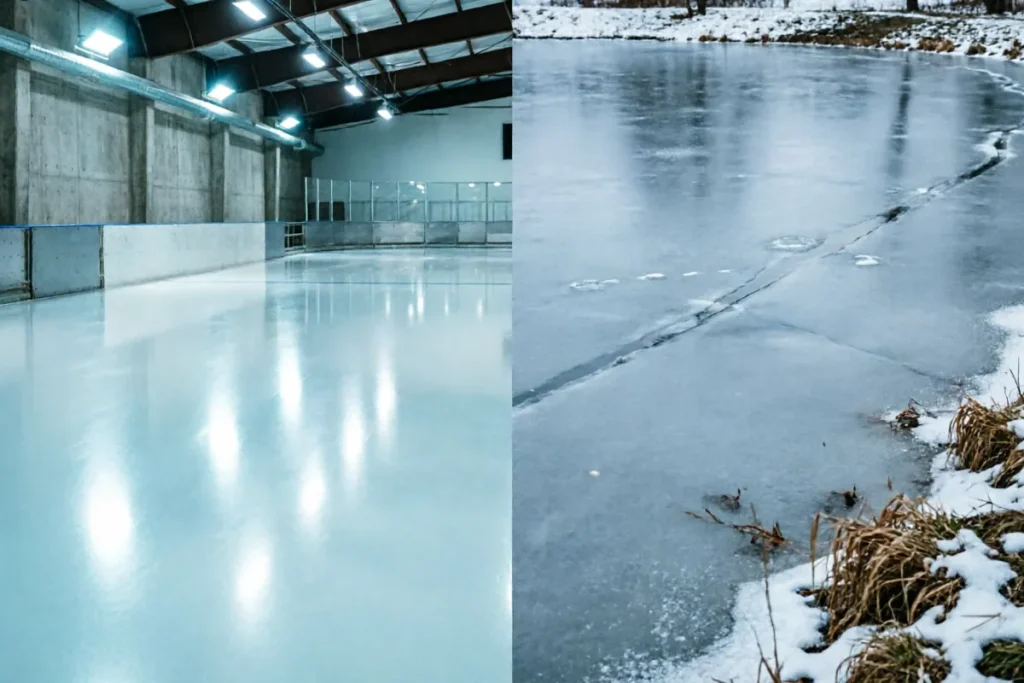
Rink ice is maintained and monitored, while pond ice forms naturally and can vary across a single surface. Neither is safe by appearance alone.
The numbers
Typical maintained on-ice temperature range for indoor rinks
Extreme-cold closure threshold advised for outdoor rinks
Mild month when Ottawa’s Rideau Canal Skateway never opened
Rink Ice vs Pond Ice comes down to how the ice is formed, maintained and checked. A rink’s managed surface is not a guarantee of safety, and frozen pond ice can change with weather, water movement and local conditions. Before skating outdoors, check current local guidance and avoid ice whose safety has not been confirmed.
| Criterion | Indoor rink | Outdoor pond |
|---|---|---|
| Surface conditions | Maintained ice | Changes with weather and sunlight |
| Temperature detail | Typically 17 to 29 degrees on the ice | Can soften during the day in direct sunlight |
| Cold-related surface issue | Temperature can affect performance and equipment choice | Very hard ice can chip and flake in shards |
| Safety check | Check current rink operating notice | Use local ice-safety guidance; appearance is not proof |
- Since 2013 Period RinkWatch has gathered outdoor-rink skating reports
Why is a smooth-looking pond not proof of safe ice?
A pond can look smooth and still have ice that will not support a skater, because its surface can conceal changing conditions below.
Mass.gov warns that people skating on ponds can fall through the ice and suffer cold-water exposure. A neat, unbroken surface does not tell you whether the ice is sound across the route you plan to skate.
A maintained rink and a natural pond are not equivalent safety checks. Outdoor ice can be affected by temperature: Binnie’s Skate Sharpening describes very hard, cold outdoor ice that chips and flakes rather than forming snow. That surface quality is not a test of whether pond ice is safe to stand on.
Do not treat any of these as proof:
- Colour: appearance alone cannot establish whether ice will support you.
- Smoothness: a polished-looking surface does not reveal changing conditions beneath it.
- A familiar route: past use does not replace current local safety guidance.
Before skating on a pond, follow local safety guidance rather than judging the ice by sight.
How can cold, hard ice affect skating and equipment?
Cold, hard ice can skate fast but chip and flake into shards, affecting both the skating surface and the way you should assess your equipment. Binnie’s Skate Sharpening describes this condition on outdoor lakes, ponds and community rinks; it is different from ice that wears into snow.
Chipping and flaking are reasons to treat the surface quality differently from a clean, maintained sheet. A fast glide does not show that the ice is in good condition. Check the surface itself, and do not assume speed means a particular skate setup will work well.
Temperature and equipment choice
Indoor rinks typically maintain an on-ice temperature between 17 and 29 degrees. That temperature can affect skating performance and equipment choice, so the same setup should not be assumed to suit every rink or outdoor surface.
- Outdoor lake, pond or community rink: Look for chipping and flaking in shards, rather than assuming hard ice is simply fast.
- Indoor rink: Check the rink’s conditions and consider how its on-ice temperature affects your skating and equipment suitability.
Before skating, assess the actual surface and check whether your equipment suits the conditions; hardness alone is not a reliable guide.
What maintenance changes the surface—and what does not?
Indoor rink ice is maintained between sessions, while outdoor pond ice changes with weather and direct sunlight; maintenance can improve the surface but cannot make it weatherproof.
On a pond, direct sunlight warms the surface and can soften the ice during the day, especially in late winter. Conditions can therefore change across the same sheet, even when the ice looked firm earlier.
Rural Municipalities of Alberta advises closing outdoor rinks during extreme cold at or below -20°C, heavy snowfall or freezing rain. These conditions are operational reasons to keep an outdoor rink closed, not problems that surface maintenance can correct.
What maintenance can—and cannot—do
- Indoor rink: Regular maintenance can improve the skating surface, but the rink’s ice still has a temperature that affects its condition.
- Outdoor pond: Surface work cannot prevent sunlight from warming the ice or weather from changing it. Recheck conditions before skating, particularly after snowfall, freezing rain or a warm, sunny day.
Why can a maintained outdoor rink still lose its season?
A maintained outdoor rink can lose its season when mild weather makes its ice unusable; grooming cannot control the temperatures that determine whether the surface holds up. January 2023 was so mild that Ottawa’s Rideau Canal Skateway never opened.
Since 2013, the RinkWatch citizen science project has gathered skating reports from outdoor rinks across North America. Those reports track how skating conditions vary, while the practical limit at a community rink remains the same: maintenance can shape the surface, but it cannot keep weather from changing it.
Check conditions before you go
Outdoor rink and pond ice can change with weather, so a rink that was skateable earlier may not be open or safe when you arrive. Check current closure notices before travelling to an outdoor rink or pond.
When does the usual rink-versus-pond advice not apply?
The usual rink-versus-pond advice does not apply when the ice’s temperature, maintenance or current weather changes the conditions: an indoor rink is not automatically suitable for every skater, and outdoor ice is not automatically safe.
Indoor-rink ice can affect both skating performance and equipment choice. Its on-ice temperature varies, so a surface that works for one skater or setup may not feel right for another. Check the rink’s operating information if you need to know current ice conditions.
Outdoor rinks and ponds are maintained differently, but either can become unsafe. Rural Municipalities of Alberta guidance says outdoor rinks should close during extreme cold, heavy snowfall or freezing rain. A pond also carries cold-water exposure risk if someone falls through, so use local ice-safety guidance rather than treating a maintained rink and a natural pond as interchangeable.
- Pond: Check local safety guidance before skating.
- Managed outdoor rink: Check its current operating notice for closures or conditions.
Frequently asked questions
Can you tell whether pond ice is safe by looking at it?
Why can very cold ice be difficult to skate on?
When should an outdoor rink close?
Can sunlight change outdoor ice during the day?
Sources
- Binnie's Skate Sharpening — “Pro's Corner: How Does Ice Temp Affect Skating”
- admirallakeandpondrestoration.com — “Step-by-Step Guide to Building a DIY Ice Rink on Your Pond”
- Mass.gov — “Ice and cold water safety”
- rmalberta.com — “Risk Management for Outdoor Rinks – Rural Municipalities of Alberta”
- thingstolucat.com — “An Introduction to ‘Wild’ Ice Skating”