Hockey Skate Toe Caps: Weight vs. Durability
There is no universal best balance between hockey skate toe-cap weight and durability; the right choice depends on how much protection you need and how much extra weight you’ll accept.
The numbers
Typical blade length described by CompositesWorld
Blade height described by CompositesWorld
Blade thickness range described by CompositesWorld
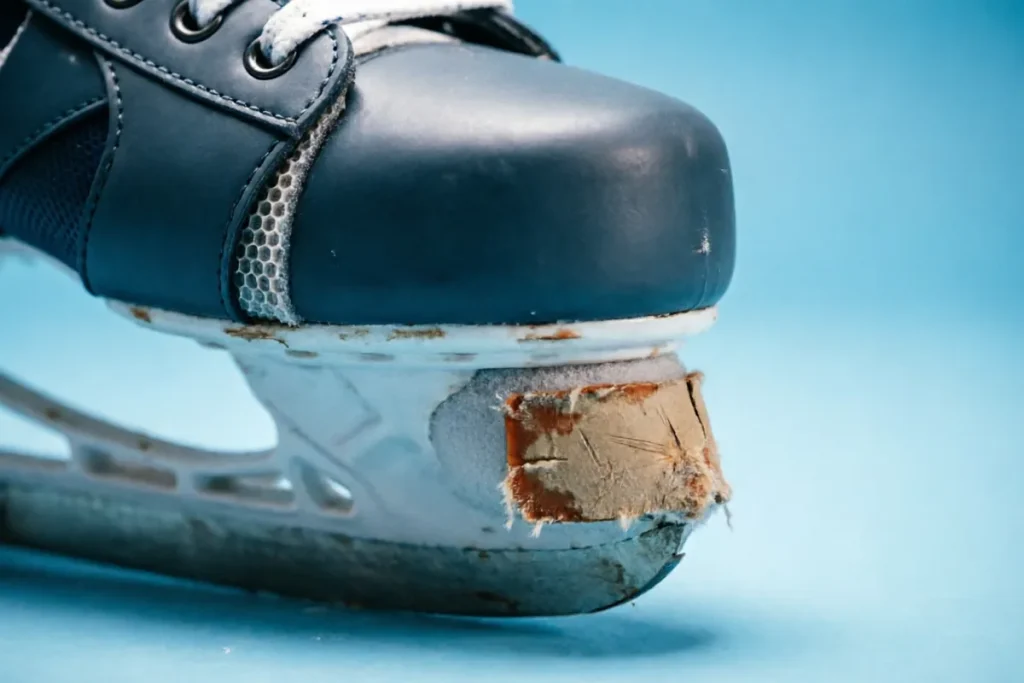
A lighter toe cap can make a skate feel less bulky, while a more robust one can better withstand impacts and repeated contact. The trade-off depends on the cap’s construction and your level of play, so compare protection and weight together rather than treating either as the only measure of quality.
| Priority | What to check | Decision limit |
|---|---|---|
| Impact protection | Toe coverage, cap-to-shell seam, documented reinforcement | No comparative impact test is provided |
| Lighter feel | Exact model weight and toe-cap construction | Composite branding alone does not establish cap weight |
| Repairability | Replaceable cap, service options and warranty | Integrated shell damage may require broader repair |
| Regular play | Whole-boot support and durability alongside toe protection | Mid-level durability descriptions do not rank toe-cap materials |
- 13 to 15 layers Material layers in the VAPOR APX stick shaft core
What materials are used to reinforce hockey skate toe caps?
Hockey skate toe caps may use different materials from the boot quarter, outsole and tongue; a composite shell alone does not identify the toe-cap construction. These parts have separate roles and can be built differently, so check the toe cap itself rather than inferring its material from the boot’s overall label.
Modern hockey skate boots use lightweight composites for stiffness and responsiveness, but that broad description does not name a toe-cap polymer, fibre weave or reinforcement. Carbon fibre and composite materials are used in premium skate construction, yet that does not establish that a particular toe cap contains either material.
What to check when comparing toe caps
- Exact skate model: Product-level details are needed to distinguish one toe-cap construction from another; “composite” is too broad to serve as a material specification.
- Manufacturer construction details: Look for an explicit description of the toe cap, separate from details about the quarter, outsole or tongue.
- FUSE X Toe Cap: The name identifies a redesigned design, but does not by itself disclose its material or reinforcement.
Weight and durability comparisons are meaningful only when the toe-cap construction is identified for each exact model. If the manufacturer does not describe that component, do not treat a feature name or the boot’s composite-shell label as proof of what it is made from.
How should you compare protection, weight and repairability?
Compare a hockey skate toe cap by checking how its coverage and reinforcement match the boot’s exposed toe, then weigh the added mass against the cap’s repair options.
Protection
Toe-cap protection depends on where the material sits and how it joins the shell, not simply on whether it is composite. Check the cap against the boot’s exposed toe area and look for product details that describe the reinforcement and attachment.
- Coverage: Match the cap’s protected area to the exposed toe of the boot.
- Construction: Check where reinforcement sits and how it is joined to the shell.
- Repair access: Find out whether the external toe piece can be replaced and what service is available if damage reaches the integrated boot structure.
Weight and repair
Added mass matters most if you are sensitive to skate feel. Toe-cap weight figures are not available for comparison here, so a numerical ranking is not justified; ask for the weight of the specific model rather than assuming composite means lighter.
For a hard shooter or frequent shot-blocker, prioritize documented toe coverage and repair access. If a lighter feel is your main concern, compare model-specific weights and check the manufacturer’s service options before buying.
How does toe-cap protection relate to the rest of the skate?
A one-piece hockey skate boot can improve energy transfer and reduce weight, but that construction alone does not establish that its toe cap resists impacts better or is easier to repair.
The FUSE X Toe Cap and one-piece Forged Carbon Outsole are presented as features associated with stiffness and power transfer. Those performance claims do not compare toe-cap durability, so assess the cap itself rather than treating the boot’s construction as a durability rating.
CompositesWorld describes most blades as 8 inches to 9 inches long (20.3 cm to 22.9 cm) and 2.5 inches (6.36 cm) high, with thickness varying from 0.350 inch (8.8 mm) at the heel to 0.150 inch (3.8 mm) at the toe. These dimensions describe blade geometry, not a toe-cap specification; overall material claims cannot replace checking each component.
Check the joint, not just the cap
- Toe-cap seam: Look for separation where the cap joins the boot.
- Surrounding shell: Check for damage or separation beside the cap.
- Outsole: Inspect its connection to the shell as well as the cap’s fit.
A strong cap cannot prevent damage at a joint where adjacent materials separate, so inspect the seam, shell and outsole together.
Which material trade-offs are clear—and which are not?
Premium-versus-mid-level descriptions support a broad trade-off: premium skates are presented as lighter and more responsive, while mid-level models emphasize support and durability for regular use; they do not establish which toe cap is tougher.
What the descriptions support
The comparison concerns whole-skate construction, not toe-cap material in isolation. A skate’s overall category cannot show whether its cap resists impact or wear better than another model’s.
CompositesWorld’s VAPOR APX example is a stick shaft, not a skate toe cap. Its core has 13 to 15 material layers, 4 inches to 60 inches (102 mm to 1,524 mm) long, arranged in alternating orientations. That construction illustrates why “composite” alone does not describe performance: the layup matters.
The VAPOR APX shaft’s stiffest region is about 18 inches/457 mm above the stick’s heel. More flexible areas sit below and above it, with one about 10 inches/254 mm on either side of the point of maximum stiffness. These shaft details cannot rank skate toe caps.
What to verify on the model
- Toe-cap material and construction: Check the specific skate’s product description; whole-boot claims do not identify the cap’s material.
- Durability evidence: Compare model-specific descriptions or ask the retailer about toe-cap protection. Do not infer toughness from a premium label or composite wording alone.
- Use case: Weigh the stated priorities—responsiveness for premium skates, support and regular-use durability for mid-level models—against the actual model details.
When does a lighter or more reinforced toe cap fail to be the better choice?
A lighter toe cap is not the better choice when its weight and construction are unclear, or when it cannot be serviced after damage; extra reinforcement is not automatically better if it adds mass.
A skate’s price tier does not establish how its toe cap performs. Even a light-material claim is difficult to assess if the manufacturer gives no toe-cap weight or explanation of its construction. Do not use the VAPOR APX stick’s carbon-layup details as evidence about a skate toe cap: they describe a different product and component.
What to check before choosing
- Toe-cap material and coverage: Ask the manufacturer or retailer what the exact model uses and which areas the cap protects.
- Construction and serviceability: More reinforcement may help with repeated contact, but it can add mass. If the toe cap is part of an integrated shell, damage may also make repair or replacement harder.
- Warranty and replacement parts: Confirm what the warranty covers and whether the toe cap or damaged shell components can be replaced.
Descriptions of toe-cap materials do not quantify the weight or protection trade-off, so do not treat either as established from the material name alone. Check the exact model’s specifications and parts options with the manufacturer or retailer before buying.
Frequently asked questions
Are composite hockey skate toe caps always lighter?
Does the FUSE X Toe Cap have a stated material?
Should a frequent shot-blocker choose a reinforced toe cap?
Can a skate toe cap be repaired?
Key takeaways
- The FUSE X Toe Cap is named, but its material is not specified here.
- Premium composite construction describes the whole skate, not proof of a tougher toe cap.
- Check toe coverage, shell seams and model-specific repair options together.
- The VAPOR APX figures describe a hockey stick shaft, not a skate toe cap.
Sources
- info.hockeybase.fi — “Hockey Skate Buying Guide 2025: Fit, Profiles & Performance Tips”
- geargeek.com — “The 10 Best Hockey Skates of 2026-27 – GearGeek”
- Goalie Coaches — “Best Goalie Skates [2026]”
- cdn2.sportngin.com — “HOCKEY SKATE SIZING”
- Puckstop — “How To Choose The Right Ice Hockey Skates & Find The Ultimate Fit”