Hockey Skate Insoles vs. Aftermarket Footbeds
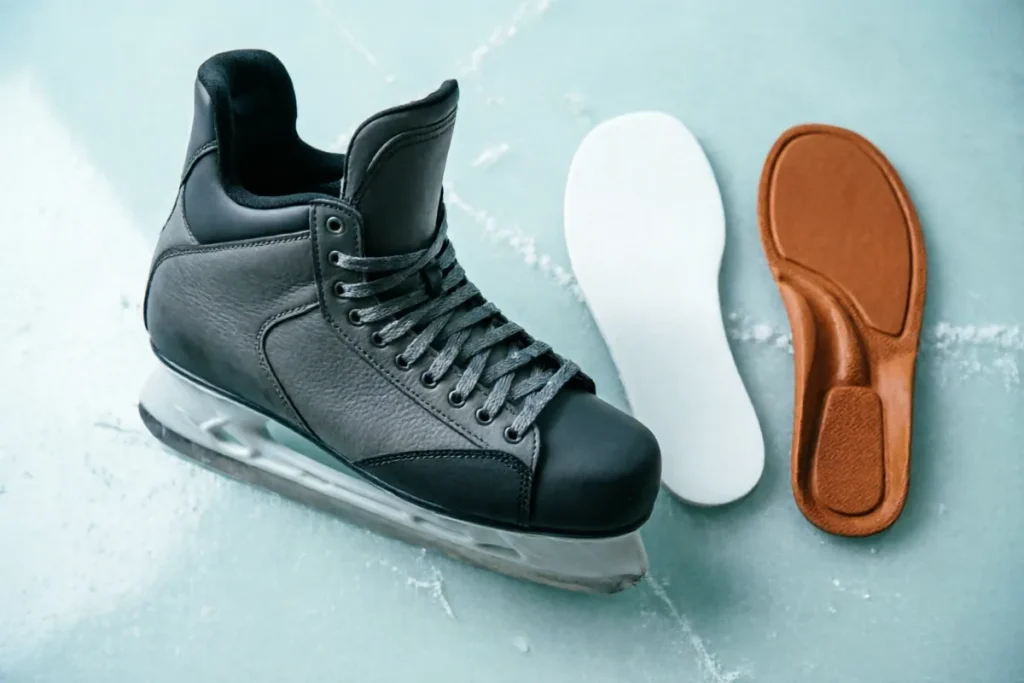
Stock hockey skate insoles are the basic inserts supplied with skates; aftermarket footbeds are replacement inserts chosen to change support or fit. Neither is automatically better—the right choice depends on your foot and how the skate fits.
The numbers
A&R Lace Bite Gel Pads original price listed by GoalieMonkey
Saving stated for A&R Lace Bite Gel Pads by GoalieMonkey
Hockey skates need a secure fit, so a footbed can affect more than comfort: it can change how your foot sits inside the boot. If the stock insole feels flat or your heel moves, an aftermarket option may help, but added support can also make a tight skate feel tighter.
This guide compares hockey skate insoles and aftermarket footbeds, explains what to check before switching, and helps you decide when the stock insert is enough.
| Option | What changes | Best fit situation | Check before buying |
|---|---|---|---|
| Stock footbed | Keeps the skate’s original underfoot setup | The skate feels secure and the footbed is comfortable | Correct skate size and footbed condition |
| Superfeet | Offers flexible cushioning or structured, responsive support | You want to change underfoot feel and can match arch shape | Thickness, arch profile and model-specific instructions |
| CURREX | Uses dynamic arch technology; hockey is among its listed sports | You want a sport-focused arch option | Exact skate model, size and fit |
| A&R Lace Bite Gel Pads | Targets localized lace-bite pressure rather than underfoot support | Pressure is concentrated around the laces | Placement and whether the pad addresses the actual pressure point |
What changes when you replace a stock footbed?
Replacing a stock footbed changes the layer beneath your foot, not the skate boot’s shape; the footbed already inside the skate is the baseline for comparison.
Stock baseline
CCM stock footbeds can be identified by the item codes SidelineSwap lists: New CCM Stock Footbeds in size 9.5 are M233, while New CCM Skate Footbeds in sizes 5–6.5 are M230. Check the size and item code when looking for a like-for-like replacement.
Replacement feel
Superfeet offers options with different underfoot feels, from flexible cushioning to more structured, responsive support. Choose based on how the footbed feels in your skate rather than assuming one style suits every boot or skater.
- Flexible, cushioned feel: Superfeet’s more adaptive option changes the feel beneath the foot without changing the boot’s shape.
- Structured, responsive support: Superfeet also offers a firmer-feeling style; try it in your skate before deciding it works better for you.
- Sport-focused design: CURREX describes its insoles as developed for sport and includes skate use among its activities. That description does not establish a head-to-head hockey performance result.
How do arch shape and skate volume affect the choice?
Match a hockey footbed’s arch shape to your own, then check whether its thickness fits the space inside your skate. A comfortable material cannot compensate for an arch that presses against your foot or leaves it unsupported.
A structured footbed takes up room inside the boot. If your skate already feels tight over the instep or forefoot, extra thickness can increase pressure; check those areas with the footbed in place, not just when trying it outside the skate.
- Superfeet: The range spans adaptive cushioning and more responsive support, so consider both the arch shape and the underfoot feel when choosing.
- CURREX: Its dynamic arch technology is designed for different sports, including hockey. Check that the model’s arch profile suits your foot and fits your skate.
- CCM Orthomove: GoalieMonkey lists the CCM Orthomove Hockey Skate Insoles as the ’21 Model. Check the model and size against your skate rather than treating the name alone as proof of fit.
Fit is the deciding check: lace the skate with the footbed installed and notice whether the arch feels supported without pressure, and whether the instep and forefoot remain comfortable. If the skate feels tighter, compare a lower-volume footbed or ask a skate fitter to assess the fit.
Can hockey skate footbeds be heat-molded?
Hockey skate footbeds can be heat-molded only if the specific footbed is designed for heat molding and the skate manufacturer permits heating the boot; check both sets of instructions before applying heat.
Superfeet, CURREX and CCM footbeds should not be treated as heat-moldable based on comfort or fit descriptions alone. A footbed that adapts or conforms as you wear it is not necessarily made to be heated. Do not transfer a molding method from another product: heat can affect materials, and the permitted method depends on the exact footbed and skate.
- Superfeet: Confirm heat-molding instructions for the exact model; descriptions of flexible cushioning or structured support do not establish heat compatibility.
- CURREX: Its sport-specific, dynamic arch design does not by itself mean the footbed can be heat-molded.
- CCM: Check the instructions for the specific footbed and skate rather than assuming a method used for another CCM product applies.
Do not confuse skate shoes with hockey skates
FP Alpha Skate Shoes are described with Kingfoam Elite Quantum custom orthotic insoles and heat-activated heel support. Those are features of skate shoes, not proof that a hockey skate footbed can be heated or molded.
If you need a custom fit, verify heat-molding compatibility for the footbed and whether the skate manufacturer allows heat in that boot. If either instruction is unclear, check with the manufacturer before proceeding.
When can a footbed help—and when can it not?
A footbed can change the support and cushioning beneath your foot, but it cannot make a hockey skate boot longer, wider or differently shaped.
Fit problems
If pressure comes from a poor skate fit, a new insert may move the pressure rather than remove its cause. Before buying a footbed, recheck these fit points:
- Boot length: Check whether the skate is too short.
- Width and shape: Check whether the boot matches your foot.
- Heel hold: Make sure your heel is held securely.
- Instep pressure: Check whether the boot presses across the top of your foot.
Localized pressure
If discomfort is concentrated at the tongue or ankle, identify the exact contact point before choosing between an insole and a gel pad. A footbed changes the surface beneath the foot; a targeted pad addresses contact at a particular area of the skate.
Goaliemonkey lists A&R Lace Bite Gel Pads as a pair, with an original price of $49.99 and a stated saving of 32%. They are a separate targeted product, not a replacement footbed. A&R Ankle Gel Pad – 4 Pack is another distinct product; check which area needs relief before selecting a pad.
How should you compare cost and choose?
Choose between a stock hockey skate footbed and an aftermarket replacement by comparing fit, support and current price for the exact model—not by treating different products as like-for-like alternatives.
- Price: The available price detail is for A&R Lace Bite Gel Pads, which are not a direct price comparison between stock and aftermarket footbeds. Check current prices for the exact footbed size and model before deciding.
- Fit: An aftermarket footbed is a better choice when its arch contour and thickness suit your foot and skate. Keep the stock footbed if it feels comfortable and maintains a secure fit.
- Identification: Before ordering, verify your skate size, footbed length, arch profile, thickness and the seller’s return terms. SidelineSwap’s listings for CCM stock footbeds show why identifying the size-specific item matters.
Test before you replace
Start with the stock setup and note how it feels underfoot during skating. Then change one variable at a time: try the replacement without also changing skate fit or another part of your setup. That makes it easier to tell whether the new footbed improves support or simply shifts pressure to another area.
Frequently asked questions
Will an aftermarket footbed make my hockey skates fit better?
Are Superfeet and CURREX hockey footbeds the same?
Can I heat-mold any hockey skate insole?
What is the difference between a footbed and a lace-bite gel pad?
Key takeaways
- Superfeet offers different underfoot feels, from flexible cushioning to structured response.
- CURREX emphasizes dynamic arch technology and includes skate use.
- Check boot volume before choosing a thicker footbed.
- A&R Lace Bite Gel Pads address localized pressure, not underfoot support.
- Confirm heat-molding instructions for the exact product.
Sources
- yoursole.com — “The Best Insoles for Skiing 2025/26 – The Lightest Tread”
- Superfeet Worldwide — “How To Choose Which Superfeet Insoles Are Right For You”
- inlinewarehouse.com — “Medium Profile Ice Hockey Skates – Inline Warehouse”
- fpfootwear.com — “FP Alpha Skate Shoes”
- currex.com — “CURREX Insoles | Shoe, Cleat, Boot & Skate Insoles for Every Activity”