Simple Skateboarding Tricks Before Your First Ollie
Before your first ollie, practise pushing, turning, stopping and riding over small cracks with control. These simple skills build balance and board confidence without requiring you to leave the ground.
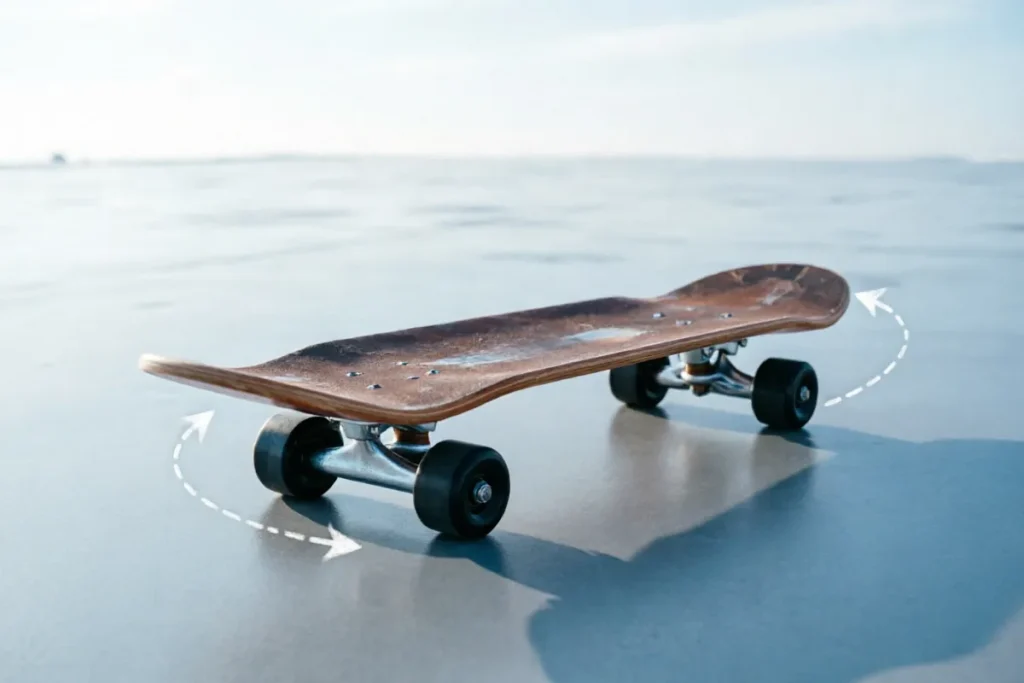
Start on smooth, flat ground and work at a pace that feels comfortable. As you get steadier, try gentle turns and small changes in surface, keeping your knees soft and your eyes ahead.
These simple skateboarding tricks give you a practical foundation for learning your first ollie: you’ll be more comfortable controlling the board before adding a jump.
| Trick | Movement | Main skill | Good starting condition |
|---|---|---|---|
| Tic-tac | Alternate small pivots while rolling | Weight shifts and direction control | Slow roll on smooth, open ground |
| Kickturn | Lift the front wheels and pivot around the rear wheels | Shoulder-led turning and balance | Nearly stationary on flat ground |
| Riding switch | Ride with the opposite stance | Foot placement and balance in an unfamiliar stance | Straight, clear path |
| Ollie | Pop the tail and level the board in the air | Timing, board levelling, and landing control | After basic riding feels comfortable |
- more than 440 random skate tricks Trick selection stated in the Game of S.K.A.T.E. app listing
What should you be able to do before trying simple skateboarding tricks?
Before trying simple skateboarding tricks, you should be able to stand comfortably, push off and ride in a straight line while keeping your weight centred. Start on a stationary skateboard with relaxed knees and your feet positioned over the deck; get used to how the board feels beneath you before rolling.
Once standing feels steady, practise pushing and riding on smooth, open flat ground. Aim to travel straight without leaning heavily to either side, and keep your knees loose so you can adjust your balance as the board moves. Wear a helmet and protective pads, and choose a clear area away from traffic and obstacles.
Use comfort as your readiness test
Try an ollie when standing, pushing and riding feel familiar—not just because it is the next trick to learn. If you tense up, wobble or struggle to keep your weight centred, return to basic riding until the board feels manageable under your feet.
How does a tic-tac build balance and board control?
A tic-tac builds balance and board control by teaching you to steer with small, alternating turns while keeping your weight centred over the deck. The movement links your shoulders and hips to the skateboard’s trucks, so you can change direction without forcing a large swing.
Keep the movement small
Start rolling slowly on flat ground, with one foot near the front bolts and the other on the tail. Shift your shoulders and hips to guide the nose from side to side, allowing the trucks to turn instead of twisting your whole body sharply.
Stay centred and alternate
Keep your knees soft and your weight over the middle of the deck. As you turn, let the tail lift only enough for a small pivot; a high lift or hard stomp makes the movement less controlled.
- First turn: Guide the nose gently to one side with your shoulders and hips.
- Return turn: Use the same small movement in the opposite direction, keeping your knees bent and weight centred.
- Next step: Practise alternating turns until they feel controlled, then use tic-tacs to change direction or regain momentum.
How does a kickturn differ from a tic-tac?
A kickturn changes the board’s direction by pivoting on its rear wheels while the front wheels lift briefly; a tic-tac changes direction through repeated weight shifts and alternating turns. The kickturn is one deliberate pivot, while a tic-tac uses a sequence of smaller movements.
Backside and frontside
For a backside kickturn, look over your back shoulder and turn your shoulders that way before guiding the board around. For a frontside kickturn, open your shoulders toward the front of the board and turn in that direction; in both cases, let your shoulders lead the pivot.
- Kickturn: Lift the front wheels and pivot around the rear wheels to make one controlled change of direction.
- Tic-tac: Shift your weight from side to side, lifting and turning the front of the board in alternating directions to build momentum.
Practise a kickturn on flat ground while nearly stationary, focusing on balance and a controlled pivot. Once that feels steady, repeat the same movement at a slow roll; avoid rushing the turn or lifting the front wheels higher than needed.
What does riding switch teach before an ollie?
Riding switch teaches you to recognise how your feet and board respond in the stance opposite your usual one, building balance and board awareness before an ollie. The stance may feel unfamiliar, so choose a straight, clear path and concentrate on staying steady rather than gaining speed. Keep your route free of obstacles so you can focus on how the deck moves beneath you.
Build the stance before adding a trick
Practise switch in stages: stand on the board, push, then roll while maintaining your balance. Get comfortable with each step before trying a turn or trick in that stance. This gives you a chance to notice where your feet sit and how the board responds without adding the extra challenge of a manoeuvre.
Switch riding also helps you compare how the same board feels under either stance. Pay attention to foot placement and the board’s response as you stand, push and roll; that awareness gives you a useful foundation for learning an ollie, where controlling your feet and board together matters.
How can a solo skater practise trick names without trying them?
Practise trick names without trying them by using a turn-based Game of S.K.A.T.E. format or a trick-calling app, and treat each generated trick as a prompt rather than an instruction. In a regular game, players take turns calling and attempting skateboard tricks; solo practice lets you learn the names and consider what they involve without committing to a move before you feel ready.
The Game of S.K.A.T.E. app listing says it supports up to 9 players or solo practice, and includes more than 440 random skate tricks. For a solo session, generate a trick, say its name aloud, and decide whether it is familiar, unfamiliar or one you want to learn about before attempting it. You can skip a prompt if you are not ready to try that move.
Use random prompts without pressure
The Game of SKATE or ANYTHING app listing describes an update that prevents random tricks from repeating. That can keep a practice session moving through different names, but a prompt is not a readiness test: stick to tricks you can approach safely, and leave unfamiliar moves for later.
When do these beginner tricks stop being a good choice?
Tic-tacs and kickturns stop being enough when you need to learn the ollie’s pop, front-foot slide and controlled landing: they build flat-ground control but do not teach those ollie movements. Keep practising them for board awareness, while treating the ollie as a separate skill rather than a trick they can substitute for.
Common control errors
A kickturn becomes unstable when you lift the front wheels too high or turn your shoulders before your balance is set. Keep the movement controlled: stay balanced over the board, then turn without throwing your upper body ahead of your feet.
- Riding switch: Practise in your opposite stance to develop board control, but return to your comfortable stance if the unfamiliar position makes your riding less controlled.
- Ramps, ledges, boardslides and grinds: Wait until basic riding and stopping feel controlled before trying these. Flat-ground practice is a better choice while those fundamentals still need work.
Frequently asked questions
Are tic-tacs and kickturns good first skateboard tricks?
Yes. Both can be practised on flat ground and help develop turning control before an ollie.
Should I learn to ride before trying a kickturn?
Yes. First get comfortable standing, pushing, balancing, and rolling in a straight line so you can focus on the pivot.
What does riding switch mean?
It means riding with your opposite stance. Begin with standing and rolling on a clear, flat path before adding turns.
Can I practise skate tricks alone?
Yes. The Game of S.K.A.T.E. app listing says it allows solo practice as well as play with up to 9 players.
Key takeaways
- Learn to stand, push, and roll comfortably before adding tricks.
- Use small tic-tacs to practise weight shifts and truck turns.
- Practise kickturns on flat ground, starting nearly stationary.
- Ride switch for stance awareness, but return to your usual stance if control slips.
Sources
- stokedrideshop.com — “20 Easy Beginner Skateboard Tricks You Must Learn in 2025”
- wikihow.com — “How to Ollie: A Complete Beginner’s Guide”
- superprof.com — “Master Cool Skateboard Tricks for Beginners”
- redbull.com — “Skateboard tricks for beginners: The top 9 to learn”
- howtoskate.com.au — “Skateboard Trick Roadmap – The best skateboarding tricks for beginners to learn — How To Skate Professional Skateboard Coaching in Sydney”