When Are Custom Orthotics Worth It for Hockey Skates?
Custom orthotics are worth considering for hockey skates when a properly fitted stock footbed still leaves you with persistent discomfort or a fit problem that affects skating. They are not an automatic upgrade for every player.
The numbers
Skaters included in the study
Age range of skaters in the study
Prevalence of most listed conditions in elite versus nonelite skaters
In a tight skate, foot support can change how your foot sits and how the boot feels. The useful question is whether an orthotic addresses a specific problem—not whether custom is inherently better. Before deciding, consider the fit of the skate itself and ask a qualified professional to assess your feet and skating needs.
| Option | What it offers | Best next check |
|---|---|---|
| Stock footbed | The footbed supplied with the skate | Check comfort, support and whether it lies flat |
| Superfeet Hockey Insoles | A hockey-specific replacement footbed | Check thickness and fit in your skate |
| Custom orthotic | A device moulded to an individual foot | Ask a professional to assess foot and skate fit |
- 43% of female skaters and 46% of male skaters Skaters reporting overuse syndromes
- $199 The FootLab MN price listed for a kids full custom orthotic
What can custom orthotics change inside a hockey skate?
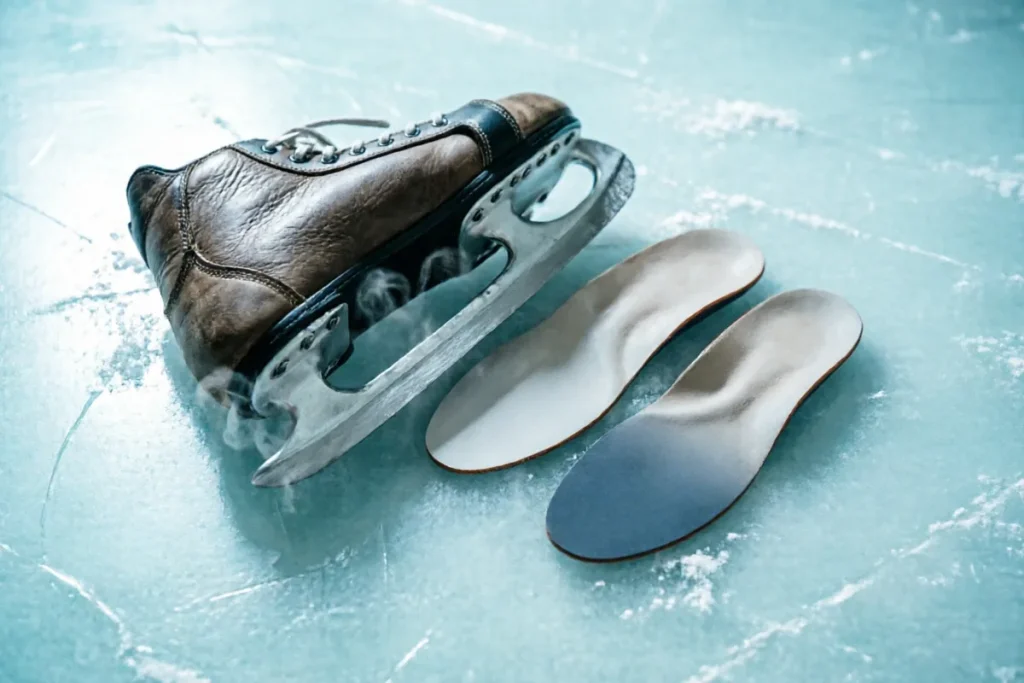
A custom orthotic changes how your foot sits against the hockey skate’s footbed: moulded to your foot, it can fill a gap between the sole and the footbed and create closer contact inside the boot.
That closer fit may reduce pressure points and help your foot feel more stable. Hockey orthotics are designed around skating posture and force transfer, rather than simply reproducing the heel-to-toe support used for walking.
Better contact may also help you feel the skate’s edges more consistently. It does not replace skating practice or correct poor technique; the orthotic changes the fit, while edge control still depends on how you skate.
How does a custom orthotic compare with a stock footbed?
A custom orthotic is shaped to your foot and can address a specific fit or support need; a stock footbed or hockey-specific replacement may be enough if it sits comfortably and fits the skate. More personalisation does not guarantee better skating.
- Stock footbed: Check that it lies flat, supports your arch comfortably and does not bunch inside the skate.
- Superfeet Hockey Insoles: This hockey-specific replacement is designed for use in skates, but it is not made from an individual mould of your foot.
- Custom orthotic: Its individual shape may suit a particular support or fit need, but it still has to fit the boot.
For any option, compare its thickness and shape with the skate’s available volume. If an insert lifts your foot or crowds the boot, it can worsen the fit rather than improve it.
When is a custom orthotic worth considering?
Custom orthotics are worth considering when recurring discomfort or pressure remains after you have checked skate sizing, lacing and footbed placement.
During an assessment, describe any tendency for your foot to roll outward, uneven pressure inside the boot or difficulty feeling stable. These patterns can help a clinician decide whether an orthotic is appropriate; they do not, by themselves, establish that you need one.
If the stock footbed feels comfortable and your skate feels secure, there may be no clear reason to pay for a custom device. Before proceeding, ask how the proposed orthotic will fit inside your particular skate and whether the clinician can assess the boot as well as your foot.
When is professional assessment more useful than buying inserts?
Professional assessment is more useful than buying inserts when you need to identify what is causing discomfort or how an insert will fit your hockey skate. A clinician can examine foot position and pressure instead of asking you to guess which shape might help.
Bring your hockey skates and current footbeds to the appointment. The boot’s fit and the space available inside it affect whether a device can be added without making the skate too tight.
If discomfort is persistent, worsening or present outside skating, seek clinical advice rather than treating an insert as a diagnosis.
- Ask what specific problem the device is intended to address.
- Ask how its fit will be checked in your skate.
- Ask what to do if the skate feels tighter after fitting.
What does skating research say about foot problems?
Skating research describes foot and leg problems across disciplines, but it does not show that custom hockey orthotics prevent injuries or improve performance. The study included 20 male skaters and 75 female skaters, aged 6 to 33 years, with a mean age of 14.2 ± 5.6 years; participants represented several skating disciplines and skill levels.
Most listed conditions were 10% to 32% more prevalent in elite skaters than in nonelite skaters. Overuse syndromes were reported by 43% of female skaters and 46% of male skaters. Stress fractures, jumper’s knee and shin splints were most common among single and pair skaters.
These findings describe skaters across disciplines. They are not a test of orthotics in hockey, so they cannot establish whether custom inserts change a hockey player’s injury risk or performance.
When can an orthotic fail to solve the problem?
A custom orthotic cannot solve a problem caused by the wrong skate size, a loose heel, poor lacing, a damaged boot or a blade setup that feels wrong. Because the device takes up space inside the boot, it can increase pressure rather than improve comfort.
Claims that a custom orthotic will prevent injuries or automatically improve edge control go beyond what an individual fit assessment can establish. An orthotic may address foot support, but it cannot correct every part of how a skate fits or performs.
If the skate feels worse
Stop skating in a skate that feels worse after you insert an orthotic. Have the skate fit checked before changing or modifying the device; added pressure may point to a fit problem that the orthotic cannot fix.
How should you compare the cost before ordering?
Compare the full purchase and fitting cost of a custom orthotic with a suitable stock footbed in your own hockey skate, then judge both by comfort, pressure and secure fit.
The FootLab MN lists a $199 full custom orthotic for kids, but lists adult orthotics separately without a price. Those figures are not a like-for-like comparison. The FootLab MN describes a one-hour process, with customers leaving the appointment with their orthotics; confirm that the service and listed price apply to your needs.
- Total cost: Ask what you will pay, including any assessment or fitting charges.
- Adjustments and returns: Confirm how adjustments are handled and check the return policy before ordering.
- Fit in your skate: Compare the custom orthotic with a suitable stock footbed in the same skate, focusing on comfort, pressure and whether your foot stays secure.
Sources
- upstep.com — “Best Insoles for Hockey Skates for Enhanced”
- Superfeet Worldwide — “Superfeet Hockey Insoles: The Ultimate Assist”
- Edmonton Foot Clinic — “Expert Custom Orthotic Skates in Edmonton”
- mph-health.com — “Boost on-ice performance with hockey skate orthotics – SW Calgary Chiropractor & Massage Therapy Clinic”
- Kintec: Footwear + Orthotics — “The Benefits of Skate Orthotics”