Ice Rink Humidity: Why Condensation Softens Ice
Condensation softens rink ice when humid air meets a colder surface: water forms on the ice, adding moisture that can weaken its top layer. Controlling rink humidity helps limit that effect.
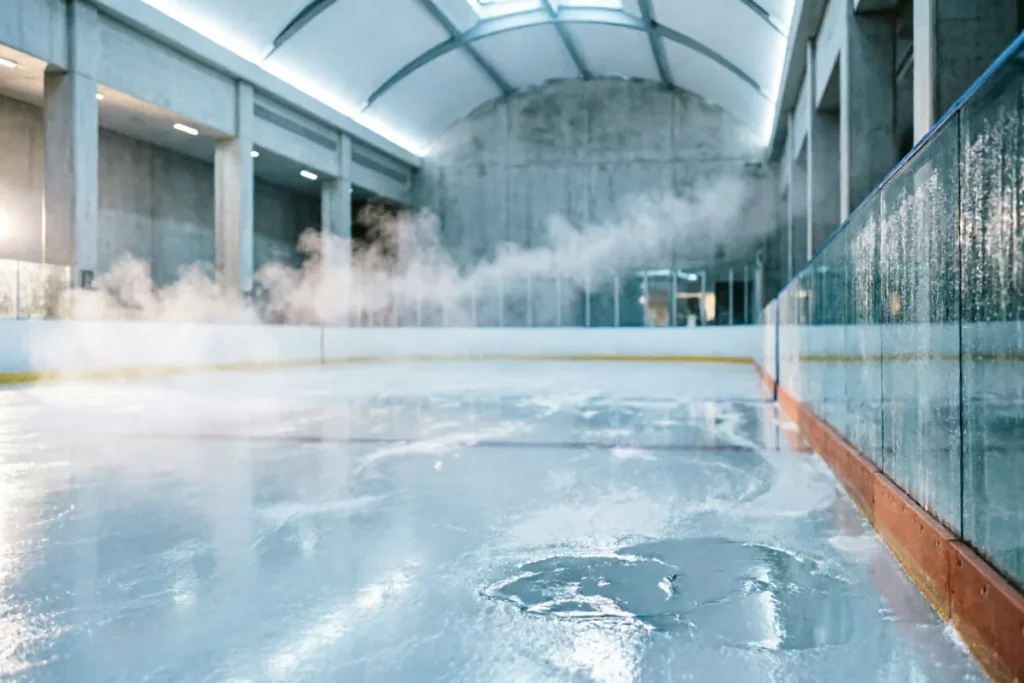
Ice rink humidity matters because the air and ice exchange heat and moisture. When warm, damp air reaches the colder rink surface, condensation can make the ice wet and less firm; how much it affects skating depends on rink conditions and how well the air is controlled.
| What you observe | What it may indicate | What to check next |
|---|---|---|
| Wet or uneven ice | Condensation collecting on the ice | Indoor air moisture and the affected surface area |
| Fogged glass | Moisture condensing on a cold surface | Whether other rink surfaces are also damp |
| Wet seats or handrails | Condensation beyond the ice surface | Ventilation conditions and indoor moisture control |
| Curling ice changes | Condensation may affect the pebble and curling conditions | Dew-point control, not relative humidity alone |
Why does warm, humid air condense on cold rink ice?
Warm, humid rink air condenses on cold ice when it cools at the surface and can no longer hold as much moisture; water then collects on the ice. The rink’s broad frozen surface is continually exposed to warmer indoor air, so condensation can form across the skating area.
Condensation makes rink ice wet and uneven. For skaters, that can mean less predictable contact with the surface and more difficulty making quick turns or stops. A thin film of moisture may be hard to see, but it can still change how the ice feels under a blade.
Cold glass, seats and handrails can also collect condensation. Those wet surfaces create a separate slip hazard for people moving around the rink, even when the ice itself is not the immediate concern.
Why both temperature and humidity matter
Air temperature and humidity work together: temperature affects how much moisture the air can retain, while humidity indicates how much moisture it already contains. Changing only one may leave condensation unresolved. Rink operators need to consider both indoor air conditions and the cold surfaces where moisture is collecting.
What mistakes make fog and changing ice conditions harder to diagnose?
Fog is not merely a visibility problem: it can accompany condensation on the ice and other rink surfaces, where moisture may make the ice uneven or slippery. Treating fog as a visual nuisance alone can therefore leave a surface hazard unchecked.
A rink can feel comfortable while excess moisture still affects the ice. Your impression of the air is not a reliable test of whether condensation is collecting on the cold surface.
- Check more than the ice. Look for visible moisture on the glass, seats and handrails as well as on the skating surface; condensation on these surfaces can also create slip hazards.
- Do not assign every slick patch one cause. First check where moisture is visible, then note whether the patch is on the ice or another surface.
- Reassess over time. Ice conditions can change as indoor air interacts with the cold surface, so a single inspection may not describe conditions later in the session.
Keep observations tied to specific places and moments. If a patch changes or reappears, record where it is and what other surfaces are wet before drawing conclusions about the ice.
How can you tell whether humidity or ventilation is contributing?
Condensation on the ice and other arena surfaces, especially when it appears near a wet or uneven ice patch, is a practical sign that moisture and air movement may be contributing.
- Check other surfaces: Fogged glass, wet seats and damp handrails suggest moisture is affecting more than the ice.
- Compare locations: Match visible wetness on the ice with the area that feels soft or skates unevenly. A local wet patch is a more direct clue than a general impression that the rink feels humid.
Ventilation is not dehumidification
Ventilation brings air into the arena and moves indoor air around. Outdoor air does not always dry an ice rink: when conditions are unsuitable, it can raise indoor relative humidity and encourage condensation on the cold ice.
Traditional air-handling units may not manage an ice arena’s moisture load efficiently. Ventilation and dehumidification do different jobs: changing air movement does not necessarily remove enough moisture. If wetness appears across several surfaces, ask the rink operator whether humidity control as well as ventilation is being checked.
Why is ventilation alone not always enough to clear rink fog?
Ventilation alone may not clear rink fog because outdoor air can raise indoor relative humidity rather than lower it, depending on its moisture content and the rink’s conditions.
Leonhard Ice Rink in Fribourg, home to the HC Fribourg-Gottéron ice hockey team, faced humidity challenges that affected fog formation and condensation. Moisture on the ice can soften the surface, while fog and condensation impair visibility.
At Leonhard Ice Rink, a tailored humidity-control solution featured a high-capacity Cotes C180 dehumidifier, installed by partner Krüger + Co. This was a response to the rink’s particular conditions, not a universal equipment recommendation.
Before choosing a system, assess the rink’s air conditions and identify whether the main problem is incoming outdoor moisture, condensation on the ice, or both. Ventilation and dehumidification address different parts of the moisture problem; the right choice depends on what is driving it at that rink.
When does the usual humidity advice not apply to curling?
For curling, the usual advice to control relative humidity alone does not apply: DST Dryer describes curling-rink atmospheric control as aligned with the air’s dew point rather than relative humidity alone.
Dew point is the temperature at which moisture in the air can begin to condense on a colder surface. It therefore helps rink operators assess condensation risk at the ice, rather than relying on a relative-humidity reading by itself. DST Dryer says its dehumidifiers reduce ambient humidity to help limit moisture-related problems and maintain ice quality.
Curling ice also has a surface feature that hockey ice does not share in the same way: the pebble, the textured surface that helps determine how a stone curls. Condensation can alter that pebble, leaving the ice slippery and changing a stone’s curl. The control target needs to account for the surface condition, not just the room air.
Use the needs of curling and the rink’s actual conditions to choose an atmospheric-control approach. Before applying a hockey-rink setting, check how the rink monitors dew point and whether condensation is affecting the pebble.
Frequently asked questions
Does high humidity make ice slippery?
Can ventilation make rink humidity worse?
What surfaces should rink staff check for condensation?
Is relative humidity the right target for a curling rink?
Sources
- antairsystem.com — “Our Desiccant dehumidifiers get good feedbacks from ICE hockey Arena”
- Munters — “Humidity control for ice rinks and sports facilities”
- gncc.org — “Microsoft Word – WaterInACurlingRink.doc”
- Desert Air — “Ice Rink & Ice Arena Dehumidification Systems”
- pmc.ncbi.nlm.nih.gov — “Arena ice quality and perspectives on optimizing performance and addressing emerging challenges”