Hockey Skate Size Chart: Find Your Fit
Choose hockey skates by matching your foot length to the brand’s size chart, then check the fit on your feet. Skate sizes vary by brand, so your regular shoe size is only a starting point.
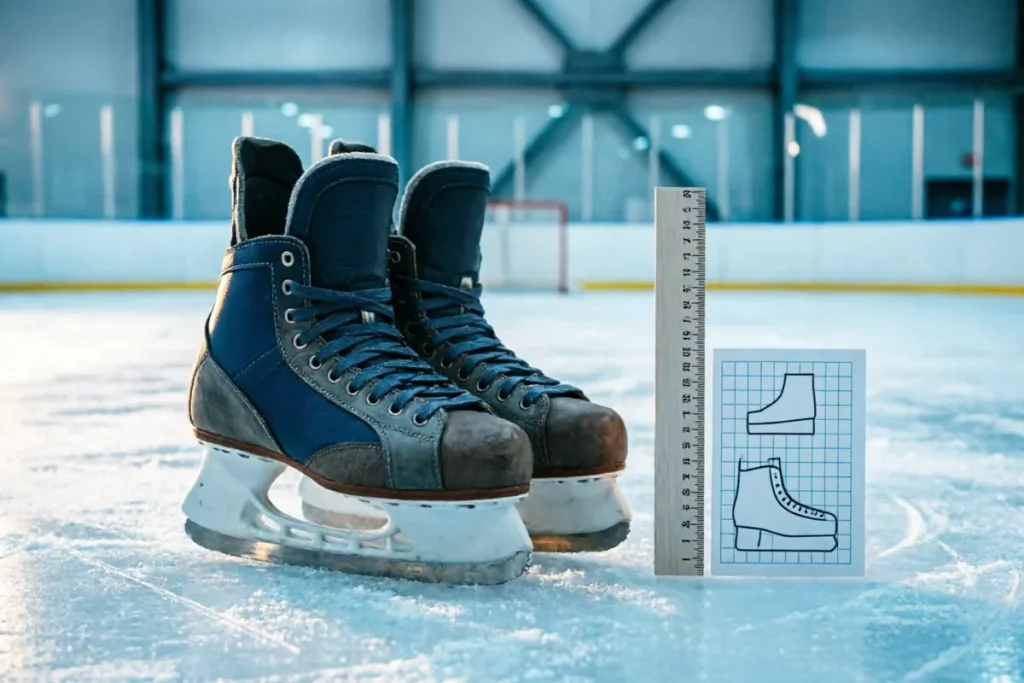
A good fit should feel snug and secure without painful pressure or toes being forced against the front. Use the chart to narrow down your hockey skate size, then try the skates on with the socks you plan to wear and check that your heel stays in place.
| Chart detail | Starting reference | What to verify |
|---|---|---|
| Men’s U.S. shoe size 9 | Hockey skate size 7.5 or 8 | Toe brush and secure heel |
| Size 10 shoe | Start with an 8.5 hockey skate | Fit in the exact skate model |
| CCM D width | Standard | Compare forefoot width |
| CCM E width | Extra wide | Check pressure across the forefoot |
| Bauer female sizing | Go down 3 sizes from shoe size | Use Bauer’s chart for the skate |
How do you measure your foot for a hockey skate size chart?
Measure both feet while standing, then use the longer heel-to-big-toe measurement and your forefoot width to check the hockey skate maker’s size chart.
Length first
For each foot, stand with your heel against a straight edge and measure to the tip of your big toe. CCM’s skate selector gives the same direction: measure from the big toe to the back of the heel. Check both feet rather than assuming they match, and use the longer measurement when consulting the chart.
Width second
Measure across the broadest part of the forefoot, then compare both your length and width with the manufacturer’s chart. CCM’s selector also asks shoppers to choose the width image that best describes their foot, with tapered, regular and wide fit options. Treat width as a separate check from length: a skate that matches your foot length may still be the wrong fit across the forefoot.
- Length: use the longer heel-to-big-toe measurement.
- Width: measure across the widest part of the forefoot.
- Chart check: compare both measurements with the specific maker’s chart and, for CCM, select the closest width image.
How do shoe size and hockey skate size compare?
Hockey skate sizes are generally one to one-and-a-half sizes smaller than regular shoe sizes, so use your street-shoe size as a starting reference rather than your final skate size. A men’s U.S. shoe size 9 typically corresponds to hockey skate size 7.5 or 8, but the best fit still depends on how the skate sits on your foot.
- Men’s U.S. shoe size 9: Begin by trying hockey skate size 7.5 or 8.
- Shoe size 10: A player who wears a size 10 shoe will typically start with an 8.5 hockey skate.
Hockey skate size labels are a fitting guide, not a guarantee that a particular pair will feel right. After choosing a starting size, check the skate’s fit against your foot length and width; brands such as CCM offer width designations, including D for standard and E for extra wide. Use the brand’s size and width chart to narrow down your choice, then assess the fit in the skate itself.
How do brand and sizing categories affect the chart?
Brand and sizing category matter because skate length and width codes must be read against the chart for the exact brand and skate line. Bauer’s female skate sizing recommends going down 3 sizes from your shoe size; do not apply that rule to another sizing category without checking its chart.
Width codes are not universal across every chart.
CCM labels width separately from length, so read both codes together. Its width guide distinguishes these options:
- C: narrow.
- D: standard width.
- R: wider than D.
- E: extra wide.
- EE: the widest.
CCM’s D and E codes are described as standard and extra wide, respectively; the wider guide also identifies C, R and EE. Before choosing a skate, compare your foot measurements with the chart for the exact brand and skate line, rather than treating one brand’s width labels or sizing rule as universal.
How should youth and junior sizes be read?
Youth and junior hockey skate sizes are age-category labels, so compare the player’s measured foot with the manufacturer’s chart rather than treating the label as a direct shoe-size equivalent. The listed Bauer youth skate sizes range from Y6.0 to Y13.5, while the general guide gives a youth-and-junior range of 6Y to 5.5, with junior sizing following youth sizing.
For a growing player, choose a skate that feels snug and comfortable, not one that is automatically larger to allow for growth. A skate that is too big can let the foot shift inside the boot, making control and comfort harder to maintain; check the fit with the skates laced and the player standing.
Check the brand’s chart
Youth and junior labels and size ranges can differ by brand, so use the manufacturer’s own chart for the specific skate. For example, compare the stated Bauer youth range with the relevant chart for another model instead of assuming its youth or junior labels match Bauer’s.
How can you confirm the skate fits after using the chart?
Confirm a hockey skate’s fit by checking toe contact, heel space, and forefoot pressure with the skate laced, then repeat the check in both skates before buying. Use the chart-based size as a starting point, not a substitute for trying the pair on.
Check the heel and toe separately.
- Toe contact: Loosen the skate and slide your foot forward until your toes just brush the front. This checks the skate’s length without the laces pulling your foot back.
- Heel space: Look down the back of the skate and check how many fingers fit between your heel and the skate. Use that space as a heel-hold check alongside toe contact.
Reassess with the skate laced.
Lace the skate as you would wear it and check whether the heel stays held, the toes still contact the front, and the forefoot feels pressured. A skate that feels different once laced needs another look: judge those three points together rather than relying on the chart size alone.
Try on both skates, since one foot may feel different from the other. Compare each skate’s heel hold, toe contact, and forefoot pressure with the chart-based starting size before deciding whether the fit works for you.
When can a hockey skate size chart lead you to the wrong choice?
A hockey skate size chart can lead to the wrong choice when its shoe-to-skate conversion matches your foot length but not its shape. The same length may feel different in narrow, regular or wide fits, so a conversion is only a starting point—not a substitute for trying on the skate.
CCM’s width labels describe fit options, not size numbers: C is narrow, D is standard, R is wider than D, E is extra wide, and EE is the widest. Choosing a larger skate just to leave room for growth can also backfire: if the heel lifts or the foot slides inside, the skate is too loose for a secure fit.
What to check when chart and fit disagree
- Width: Compare how the skate feels across the forefoot; don’t read C, D, R, E or EE as length or size increments.
- Heel hold: With the skate laced, check that your heel stays seated and your foot does not slide.
- Model-specific guidance: If the chart points to a size that feels wrong during a try-on, check the exact model’s sizing advice or ask a skate fitter before purchasing.
Frequently asked questions
How much smaller should hockey skates be than shoes?
What does D mean on a CCM hockey skate chart?
Should hockey skates feel tight at the toes?
Can I use a women’s skate conversion for any brand?
Key takeaways
- Measure foot length and width before consulting a hockey skate size chart.
- Use shoe-size conversion only as a starting point; verify toe contact and heel hold.
- Read width codes separately from skate length, including CCM’s C, D, R, E and EE.
- Check the exact brand chart, especially for Bauer female and youth sizing.
Sources
- Ice Warehouse — “How to Find Your Hockey Skate Size at Home”
- Puckstop — “How To Choose The Right Ice Hockey Skates & Find The Ultimate Fit”
- prostockhockey.com — “How to Size Hockey Skates – Pro Stock Hockey”
- us.ccmhockey.com — “Ice Hockey Skate Selector – CCM Hockey”
- SkatePro — “CCM Skates Size Guide”